425 posters, 1 videos, 9 audios, 8 topics, 53 sessions, 340 authors, 286 institutions
ePostersLive by SciGen Technologies S.A. All rights reserved.
22nd Annual Pain Medicine Meeting 2023
November 10 - 11, 2023 | New Orleans Marriott | New Orleans, Louisiana, USA

4690
PREGNANCY TESTING CHALLENGES IN TIMING AND MANAGEMENT OF CHRONIC PAIN INTERVENTIONS
Poster Presenter
Authors
Affiliations
Part of Topic
Medically Challenging Cases
Pregnancy Testing Challenges in Timing and Management of Chronic Pain Interventions
Shoran Tamura1, Naum Shaparin2, Camille Fontaine2, Sarang Koushik3, Karina Gritsenko2
1Albert Einstein College of Medicine, Bronx, NY, 2Department of Anesthesiology, Montefiore Medical Center, Bronx, NY, 3Department of Anesthesiology, Creighton University School of Medicine, Phoenix, AZ
BACKGROUND
Fluoroscopic procedures for chronic pain in pregnant patients pose fetal risks. Pre-procedure pregnancy testing is crucial, especially if radiation exceeds the teratogenic threshold. Clear pregnancy screening protocols are vital to ensure safety. This case highlights the need for clear pregnancy guidelines for chronic pain procedures, especially in sexually-active patients after recent miscarriages.
METHODS
Patient informed consent was obtained for this submission.
CASE PRESENTATION
- 43 y.o. female presenting with lumbar radiculopathy
- Degenerative disc disease at L5 confirmed through MRI
- Scheduled for b/l L5 TFESI
- Weeks prior to the procedure, the patient was found to be 10 weeks pregnant, thus pain procedure deferred
- Patient experienced a spontaneous abortion at 12 weeks gestation, followed by dilation and curettage
- Patient rescheduled b/l L5 TFESI for ongoing pain
- Pre-op workup found patient to have a positive POC urine pregnancy test three weeks after miscarriage
- Patient also reported sexual activity several days prior
- Pain team prioritized safety and postponed the fluoroscopic-guided procedure
DISCUSSION
- Challenge: Managing sexually active patients with recent miscarriages undergoing fluoroscopic-guided interventional procedures for chronic pain
- Uncertainty in test results: Positive POC urine pregnancy test possibly due to residual hCG post-miscarriage and/or recent sexual activity
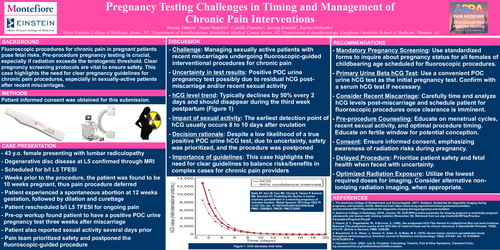
- hCG level trend: Typically declines by 50% every 2 days and should disappear during the third week postpartum (Figure 1)
- Impact of sexual activity: The earliest detection point of hCG usually occurs 8 to 10 days after ovulation
- Decision rationale: Despite a low likelihood of a true positive POC urine hCG test, due to uncertainty, safety was prioritized, and the procedure was postponed
- Importance of guidelines: This case highlights the need for clear guidelines to balance risks/benefits in complex cases for chronic pain providers
RECOMMENDATIONS
- Mandatory Pregnancy Screening: Use standardized forms to inquire about pregnancy status for all females of childbearing age scheduled for fluoroscopic procedures.
- Primary Urine Beta hCG Test: Use a convenient POC urine hCG test as the initial pregnancy test. Confirm with a serum hCG test if necessary.
- Consider Recent Miscarriage: Carefully time and analyze hCG levels post-miscarriage and schedule patient for fluoroscopic procedures once clearance is imminent.
- Pre-procedure Counseling: Educate on menstrual cycles, recent sexual activity, and optimal procedure timing. Educate on fertile window for potential conception.
- Consent: Ensure informed consent, emphasizing awareness of radiation risks during pregnancy.
- Delayed Procedure: Prioritize patient safety and fetal health when faced with uncertainty.
- Optimized Radiation Exposure: Utilize the lowest required doses for imaging. Consider alternative non-ionizing radiation imaging, when appropriate.
REFERENCES
1. The American College of Obstetricians and Gynecologists. (2017, October). Guidelines for diagnostic imaging during pregnancy and lactation. ACOG. Retrieved from https://www.acog.org/clinical/clinical-guidance/committee-opinion/articles/2017/10/guidelines-for-diagnostic-imaging-during-pregnancy-and-lactation
2. American College of Radiology. (2018, January 16). ACR-SPR practice parameter for imaging pregnant or potentially pregnant adolescents and women with ionizing radiation (Resolution 39). Retrieved from acr.org/-/media/ACR/Files/Practice-Parameters/Pregnant-Pts.pdf
3. Haenel, A. F., Hugentobler, W., & Brunner, S. (1986). Der postpartale HCG-Titer-Verlauf im mütterlichen Blut und seine klinische Relevanz [The postpartum course of the HCG titer of maternal blood and its clinical relevance]. Z Geburtshilfe Perinatol, 190(6), 275-278. [Article in German]. PMID: 2436389
4. Braunstein, G. D., Rasor, J., Danzer, H., Adler, D., & Wade, M. E. (1976). Serum human chorionic gonadotropin levels throughout normal pregnancy. American Journal of Obstetrics and Gynecology, 126(6), 678-681. doi: 10.1016/0002-9378(76)90518-4
5. Cleveland Clinic. (2022, July 8). Ovulation: Calculating, Timeline, Pain & Other Symptoms. Cleveland Clinic. my.clevelandclinic.org/health/articles/23439-ovulation.