425 posters, 1 videos, 9 audios, 8 topics, 53 sessions, 340 authors, 286 institutions
ePostersLive by SciGen Technologies S.A. All rights reserved.
22nd Annual Pain Medicine Meeting 2023
November 10 - 11, 2023 | New Orleans Marriott | New Orleans, Louisiana, USA

4673
PERIPHERAL NERVE STIMULATION AFTER UNFAVORABLE PAIN OUTCOME FOLLOWING TOTAL KNEE ARTHROPLASTY: REVIEW OF TWO CASES
Poster Presenter
Authors
Affiliations
Part of Topic
Medically Challenging Cases
Peripheral Nerve Stimulation after an unfavorable pain outcome following Total Knee Arthroplasty: A Review of Two Cases
Mark P. Pressler; Mary C. Caldwell; Bhavana Yalamuru, MBBS
University of Virginia Health System Department of Anesthesiology
Background
-
10-34% of patients who have a total knee replacement (TKR) have unfavorable long term pain outcomes (1).
-
When conservative measures (pharmacotherapy, physical therapy, TENS units) fail to provide adequate relief (2–4), nerve blocks and peripheral nerve stimulation (PNS) are options to help with chronic knee pain. (2–7).
-
Lin et al (2) describe the mechanism of PNS, discussing modulation of pain signals and inhibiting central sensitization.
-
Evidence supports PNS usage for peripheral extremity pain, neuropathic pain, migraine/cluster headache, post-amputation pain, and complex regional pain syndrome (3, 4, 7, 9, 10). Li et al discuss the most common indication for PNS is persistent post-surgical pain after 3 months (10). An RCT by Deer et al showed significant improvement in pain and quality of life (pain originated from trauma or surgery) 3 months after PNS was placed (8).
This report details two cases of peripheral mononeuropathy after TKR that benefited from temporary PNS placement and provided long term benefit.
Case Summary
-
Two females, 74 (Patient 1) and 58 (Patient 2) years old, came to the pain management center over a year after their respective TKR.
-
Patient 1, reported 6-10/10 left lateral leg pain, aching in quality with shooting pain, in the distribution of the peroneal nerve.
-
Patient 2, described 10/10 burning pain down her right lateral calf to her foot.
-
Both were taking duloxetine and gabapentin with inadequate pain control. Both received a diagnostic peroneal nerve blocks, Patient 1 reported 90% improvement and Patient 2 reported 100% improvement. They both received a temporary sciatic PNS implantation (SPRINT system, SPR Therapeutics, Cleveland OH).
-
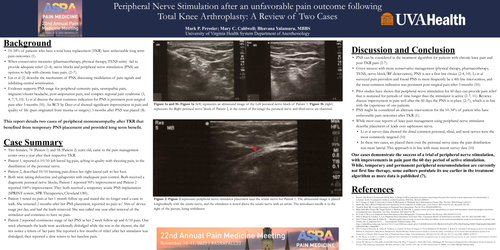
Patient 1 noted no pain at her 1 month follow up and stated she no longer used a cane to walk. She returned 2 months after her PNS placement, reported no pain w/ 5hrs of device usage per day, and had the leads removed. She was called one year after removal of the stimulator and continues to have no pain.
-
Patient 2 reported continuous usage of her PNS at her 2 week follow up and 0/10 pain. One week afterwards the leads were accidentally dislodged while she was in the shower, she did not notice a return of her pain. She reported a few months of relief after her stimulator was dislodged, then reported a slow return to her baseline pain.
Discussion and Conclusion
-
PNS can be considered in the treatment algorithm for patients with chronic knee pain and post TKR pain (2-7).
-
Given success with more conservative management (physical therapy, pharmacotherapy, TENS, nerve block/RF denervation), PNS is not a first line choice (2-4, 10). Li et al surveyed pain providers and found PNS to most frequently be a 4th line intervention, and the most common indication was persistent post-surgical pain after 3 months (10).
-
Pilot studies have shown that peripheral nerve stimulation for 60 days can provide pain relief that is sustained for periods of time longer than the stimulator is active (2-7, 11). Reviews discuss improvement in pain well after the 60 days the PNS is in place (2–7), which is in line with the experience of our patients.
-
PNS might be considered an alternate intervention for the 10-34% of patient who have unfavorable pain outcomes after TKR (1).
-
While most case reports of knee pain management using peripheral nerve stimulator describe placement of leads over saphenous nerve.
-
Li et al survey data showed the distal common peroneal, tibial, and sural nerves were the most commonly targeted (10)
-
In these two cases, we placed them over the peroneal nerve since the pain distribution was more lateral. This approach is in line with more recent survey data (10)
References
-
Deer T, Pope J, Benyamin R, Vallejo R. … blinded, partial crossover study to assess the safety and efficacy of the novel neuromodulation system in the treatment of patients with chronic pain of peripheral nerve …. Neuromodulation. Published online 2016. https://onlinelibrary.wiley.com/doi/abs/10.1111/ner.12381?casa_token=pCnU-CrGXQIAAAAA:0XA2Bj1fmL3rZYzjJYUaFTnYG6zTQaDzg1P6H41Yj8qEykqtkKGdJmt9JfNQDuONxURpz_i3q6qaPBU
-
Deer T, Pope J, Benyamin R, Vallejo R, Friedman A, Caraway D, Staats P, Grigsby E, Porter McRoberts W, McJunkin T, Shubin R, Vahedifar P, Tavanaiepour D, Levy R, Kapural L, Mekhail N. Prospective, Multicenter, Randomized, Double-Blinded, Partial Crossover Study to Assess the Safety and Efficacy of the Novel Neuromodulation System in the Treatment of Patients With Chronic Pain of Peripheral Nerve Origin. Neuromodulation. 2016 Jan;19(1):91-100. doi: 10.1111/ner.12381. PMID: 26799373.
-
Li AH, Bhatia A, Gulati A, et al Role of peripheral nerve stimulation in treating chronic neuropathic pain: an international focused survey of pain medicine expertsRegional Anesthesia & Pain Medicine 2023;48:312-318.
-
Cohen SP, Gilmore CA, Rauck RL, Lester DD, Trainer RJ, Phan T, Kapural L, North JM, Crosby ND, Boggs JW. Percutaneous Peripheral Nerve Stimulation for the Treatment of Chronic Pain Following Amputation. Mil Med. 2019 Jul 1;184(7-8):e267-e274. doi: 10.1093/milmed/usz114. PMID: 31111898; PMCID: PMC6614808.