425 posters, 1 videos, 9 audios, 8 topics, 53 sessions, 340 authors, 286 institutions
ePostersLive by SciGen Technologies S.A. All rights reserved.
22nd Annual Pain Medicine Meeting 2023
November 10 - 11, 2023 | New Orleans Marriott | New Orleans, Louisiana, USA

4591
INTRATHECAL PUMP OFFERS SUPERIOR QUALITY OF LIFE IN A PATIENT WITH HIGH GRADE METASTATIC SARCOMA
Poster Presenter
Authors
Affiliations
Part of Topic
Medically Challenging Cases
The Combined Use of Acute Regional and Interventional Pain Offers Superior Quality of Life in Palliative Care
Introduction
Cancer is a leading cause of death worldwide, accounting for approximately 10 million deaths in 2020. (1) Pain is one of the most common symptoms associated with cancer and can greatly compromise quality of life, motivation and further treatments. (2, 3) A meta-analysis revealed that 59% of cancer patients undergoing treatment reported pain, and 33% of patients continued to exhibit pain after curative treatment. (2) Evidence illustrates that quality of life and survival are linked to early and effective palliative care, including pain management. (2) Intrathecal pump (ITP) offers improved pain scores and clinical outcomes, increased survival, and reduced the adverse effects of oral analgesic regimens. (3,4)
Case
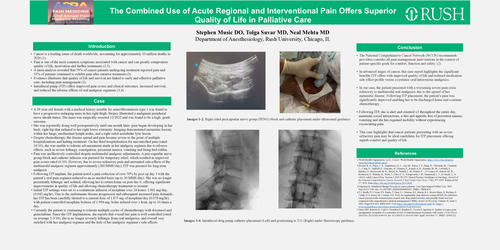
A 29 year-old female with a medical history notable for neurofibromatosis type 1 (NF1) was found to have a progressive enlarging mass in her right thigh. Biopsy illustrated a malignant peripheral nerve sheath tumor. The mass was surgically resected 12/2022 and was found to be a high- grade sarcoma. She was reportedly doing well postoperatively until one month later- pain began developing in her back, right hip that radiated to her right lower extremity. Imaging demonstrated metastatic lesions within her lungs, mediastinal lymph nodes, and a right sided acetabular lytic lesion. Despite chemotherapy, the disease spread and pain became severe to the point of multiple hospitalizations and halting treatment. On her third hospitalization for uncontrolled pain (rated 10/10), she was unable to tolerate advancements made in her analgesic regimen due to adverse effects, such as severe lethargy, constipation, persistent nausea, vomiting and being bed ridden. Pain was ineffectively controlled despite multimodal analgesic adjustments. A peri-capsular nerve group block and catheter infusion was pursued for temporary relief, which resulted in improved pain scores rated (6/10). However, due to severe refractory pain and unwanted side-effects of the multimodal analgesic regimen approximately (300 MME/day), ITP was pursued for long term analgesia. Following ITP implant, the patient noted a pain reduction of over 70% by post op day 3 with the patient’s oral pain regimen reduced to an as needed basis (up to 30 MME/day). She was no longer persistently lethargic and sedated, allowing her to return home on post day 6, offering significant improvements in quality of life and allowing chemotherapy treatments to resume. For example, she is now alert and oriented x3 throughout the entire day, maintains social interactions, a diet and appetite free of persistent nausea, vomiting, constipation, and she has regained mobility without experiencing excruciating pain. Initial ITP settings were set to a continuous infusion of morphine over 24 hours: 1.001 mg/day, (0.042 mg/hr). Due to the unfortunate disease progression and subsequent increased pain demands, her ITP has been carefully titrated to a current dose of 1.875 mg of morphine/day (0.078 mg/hr), with patient controlled morphine boluses of 1.994 mg; bolus infused over 1 hour, up to 10 times a day. Currently the patient is continuing to tolerate multiple cycles of chemotherapy with docetaxel and gemcitabine. Since the ITP implantation, she reports that overall her pain is well controlled (rated on average 2-3/10), she is no longer severely lethargic from oral analgesics, and overall very satisfied with her analgesic regimen and the lack of her analgesic regimen’s side effects.
Conclusion
The National Comprehensive Cancer Network (NCCN) recommends providers consider all pain management interventions in the context of patient-specific goals for comfort, function and safety. (2) In advanced stages of cancer, this case report highlights the significant benefits ITP offers with improved quality of life and reduced medication side effect profile versus a comprehensive medical management depending on oral/intravenous analgesics. In our case, the patient presented with a worsening severe pain crisis refractory to multimodal oral analgesics due to the spread of her metastatic disease. Following ITP placement, the patient’s pain was significantly improved enabling her to be discharged home and continue chemotherapy. This case highlights that cancer patients presenting with an acute, severe pain or pain crisis may be ideal candidates for ITP placement offering superb comfort and quality of life.