425 posters, 1 videos, 9 audios, 8 topics, 53 sessions, 340 authors, 286 institutions
ePostersLive by SciGen Technologies S.A. All rights reserved.
22nd Annual Pain Medicine Meeting 2023
November 10 - 11, 2023 | New Orleans Marriott | New Orleans, Louisiana, USA

4535
SUBANESTHETIC KETAMINE INFUSION WITH CERVICAL SYMPATHETIC BLOCKADE AS TREATMENT OF PTSD/TBI WITH A 1-YEAR FOLLOW-UP: A CASE REPORT
Poster Presenter
Authors
Affiliations
Midwestern University Chicago College of Osteopathic Medicine
Part of Topic
Medically Challenging Cases
Title: Efficacy of Combined Subanesthetic Ketamine Infusion and Cervical Sympathetic Blockade as a Symptomatic Treatment of PTSD/TBI in a Special Forces Patient with a 1-year follow-up: A case report
Authors: Dr. Eugene Lipov, MD1, Zubin Sethi, MHA, OMS-IV2, Dr. Guriqbal Nandra, MD3, Dr. Christopher Frueh, PhD4
1Stella Center, 2Midwestern University Chicago College of Osteopathic Medicine, 3IV Solution & Ketamine Centers of Chicago, 4University of Hawaii Department of Psychology
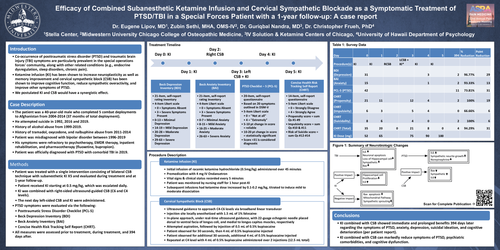
Co-occurrence of posttraumatic stress disorder (PTSD) and traumatic brain injury (TBI) symptoms are particularly prevalent in the Special Operations Forces' (SOF) community. Ketamine infusion (KI) has been shown to increase neuroplasticity and improve memory, and cervical sympathetic block (CSB) has been shown to improve cognitive function, reduce sympathetic overactivity, and improve other symptoms of PTSD. We are reporting an efficacious single intervention consisting of bilateral CSB technique with subanesthetic KI X5 in a Special Operations Forces patient, diagnosed with PTSD with comorbid TBI, evaluated during treatment and at 1-year follow-up.
Patient received total of 5 KIs and 2 CSBs. All CSBs performed with total of 12 mL 0.5% bupivacaine (4 mL administered at C4 level and 8 mL at C6 level). On Day 0, Patient received initial KI starting at 0.5 mg/kg, which was escalated daily to induce mild to moderate dissociation. On Day 1, second KI administered. On Day 2, right-sided ultrasound-guided CSB (C6 and C4 levels) administered. On Day 3, left-sided CSB and third KI were administered. Days 4 and 5, fourth and fifth KIs administered, respectively. Patient’s PTSD symptoms were evaluated using the Posttraumatic Stress Disorder Checklist (PCL-5), Beck Depression Inventory (BDI), Beck Anxiety Inventory (BAI), suicidal ideation and other related factors by Concise Health Risk Tracking Self Report (CHRTSR). All measures were assessed prior, during, immediately after, and 394 days after treatment.
All off-label indications have been clearly indicated as such in the abstract. This was performed in a private office, Stella Center, not in an institution with IRB protocols. No IRB protocols are in place at Stella Center, accordingly, this case report was waived.
Our patient was a 40-year-old male who completed 5 combat deployments to Afghanistan from 2004-2014 (37 months of total deployment). His symptoms were refractory to psychotherapy, EMDR therapy, inpatient rehabilitation, and pharmacotherapy. His psychiatric history is significant for multiple substance use disorder, and three admittances to psychological wards for depression, PTSD, and TBI, respectively. The patient recalls previously being placed on fluoxetine and bupropion, however, at the time of KI and CSB injection, the patient was medication-free. His official diagnosis of PTSD with comorbid TBI was made with an MRI in June 2021, where white matter change was noted.
Compared to the patient’s baseline, his psychiatric profile at the one year follow-up showed sharp improvements, with reductions of 93.55% in his depression score (from severe [31/63] to mild depression [2/63]), of 86.67% in anxiety (from mild [15/63] to minimal anxiety [2/63]), of 73.81% in PTSD symptoms (from probable PTSD [42/80] to not meeting criteria for PTSD [11/80]), of 75% in suicidality (from 8/12 to 2/12), and of 100% in impulsivity (from 6/8 to 0/8).
Soldiers from the SOF community are likely to present with a PTSD/TBI mixed presentation. The neural disruptions shared by PTSD and TBI include asymmetrical white matter tract abnormalities and gray matter changes in the basolateral amygdala, hippocampus, and prefrontal cortex. These disturbances produce neuronal degeneration, axonal injury, and dendritic spine dysregulation. TBI induces a multifaceted range of immunological and inflammatory tissue responses with similarities to ischemia and reperfusion injury.
Neuronal apoptosis is the main characteristic of secondary brain injury, and in the human hippocampus, neuronal cell death is evident up to 1 year after TBI. TBI can induce expression of the apoptotic protein bcl-2-like protein 4 (BAX). Additionally, stress exposure can persistently upregulate brain expression of BAX in a zebrafish model. TBI is correlated with an exaggerated stress response due to plasma catecholamine levels, known as sympathetic storming. This is also known as autonomic dysfunction syndrome, as autonomic balance dysregulation results from loss of cortical control due to brain injury. One explanation for the development of PTSD is an acute increase in Nerve Growth Factor (NGF) and mediated growth of sympathetic neurites, eventually leading to an increase in brain norepinephrine and ensuing symptoms of PTSD.
Potential mechanisms of the combined effect of KI and SGB have been theorized. Literature demonstrates that KI can produce changes associated with improvement in neurogenesis-related behavioral recall tasks, suggesting a possible benefit from ketamine administration following TBI in mice. Similar findings have been shown by Browne, who found that ketamine may be effective for treating neuropsychiatric complications that emerge following mild single-blast overpressure (mbTBI), which is a common type of injury in SOF.
Dr. Liriano reported a near complete resolution of PTSD symptoms over the short term and seemed to have similar findings regarding the use of ketamine in major depression. It is thought that upregulating Brain-Derived Neurotrophic Factor (BDNF) and antagonizing NMDA serve to reverse some of the damage caused by chronic stress. Yet ketamine can induce toxicity in human neurons through reactive oxygen species-mediated activation of the mitochondrial apoptotic pathway and autophagy. Literature demonstrates that ketamine induces apoptosis via activation of the mitochondrial pathway by increasing the expression of BAX and concomitantly decreasing the expression of Bcl-2 (BAX antagonist).
The finding of interest is that SGB can reduce the apoptosis of neurons in rats and improve brain injury by inhibiting the expression of BAX. SGB can prevent pathological damage of the hippocampus and maintain spatial learning and memory function in a sleep deprived rat model. This occurs due to reduced expression of IL-6, IL-1β and Caspase-3 in the hippocampus. SGB can reverse sympathetic sprouting by reducing NGF-regulated neurite growth, thus opposing the effect of KI. This is partly responsible for the rapid and persistent reduction of the PTSD symptoms known to be related to heightened norepinephrine levels. SGB is thought to reduce concentration of NGF and norepinephrine while inducing sympathetic pruning, which is the removal of extra sympathetic neurite growth, leading to a reduction of PTSD symptoms.
CSB and KI have been the most impactful interventions in this patient’s daily life. He is now present and able to complete work without the invasive memories of the past. His memories and traumatic events through the deployments seem as if they are long ago memories. Low moods are no longer a constant for him, neither are depressive symptoms previously prominent in his life.