425 posters, 1 videos, 9 audios, 8 topics, 53 sessions, 340 authors, 286 institutions
ePostersLive by SciGen Technologies S.A. All rights reserved.
22nd Annual Pain Medicine Meeting 2023
November 10 - 11, 2023 | New Orleans Marriott | New Orleans, Louisiana, USA

4976
THE CONSERVATIVE MANAGEMENT OF AN INTRATHECAL INFUSION SPINAL CORD ABNORMAL T2 SIGNAL: CASE REPORT AND LONG-TERM FOLLOW-UP
Poster Presenter
Authors
Affiliations
Part of Topic
Medically Challenging Cases
The Conservative Management of an Intrathecal Infusion Spinal Cord Abnormal T2 Signal
James O’Malley, Jennifer Grimmer, Marta Bentley-McLachlan, Timothy Bazil, Benjamin Matson, Oscar de Leon-Casasola
Roswell Park Comprehensive Cancer Center | University at Buffalo
BACKGROUND
Intrathecal therapy has been shown to be effective in controlling both nociceptive and neuropathic pain1 and is currently recommended for the management of cancer-related pain1,2. Catheter tip associated granuloma is a well described complication of this therapy. There is an association between granuloma formation as the drug concentration increases.3 We are reporting a case of conservative management of a patient who developed neurological symptoms and was found to have abnormal T2 signal in the MRI but no evidence of a granuloma that was managed successfully without explantation.
METHODS
According to the Roswell Park Comprehensive Cancer Center IRB, no approval was needed for the report However, a signed patient consent to have the case presented was obtained.
CASE REPORT
A 55 year old male with PMHx of HTN, HLD, CAD, MI, DM Type 2, COPD, fibromyalgia, and bilateral Renal Cell CA s/p bilateral partial nephrectomies in 2007 was initially referred in 2008 for post-nephrectomy pain syndrome. Having failed oral medical management a Medtronic Synchromed II intrathecal drug delivery device was implanted on 8/2008.
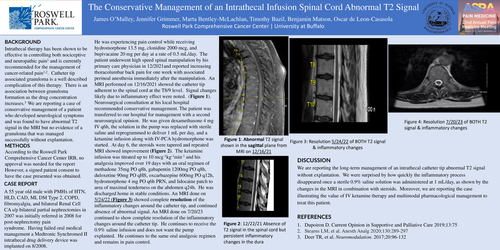
He was experiencing pain control while receiving hydromorphone 13.5 mg, clonidine 2000 mcg, and bupivacaine 20 mg per day at a rate of 0.5 mL/day. The patient underwent high speed spinal manipulation by his primary care physician in 12/2021and reported increasing thoracolumbar back pain for one week with associated perineal anesthesia immediately after the manipulation. An MRI performed on 12/16/2021 showed the catheter tip adherent to the spinal cord at the T8/9 level. Signal changes likely due to inflammatory effect were noted. (Figure 1). Neurosurgical consultation at his local hospital recommended conservative management. The patient was transferred to our hospital for management with a second neurosurgical opinion. He was given dexamethasone 4 mg IV q6h, the solution in the pump was replaced with sterile saline and reprogrammed to deliver 1 mL per day, and a ketamine infusion along with IV-PCA hydromorphone was started. At day 6, the steroids were tapered and repeated MRI showed improvement (Figure 2). The ketamine infusion was titrated up to 10 mcg-1kg-1min-1 and his analgesia improved over 19 days with an oral regimen of methadone 35mg PO q8h, gabapentin 1200mg PO q8h, duloxetine 90mg PO qHS, oxcarbazepine 600mg PO q12h, hydromorphone 4 mg PO q6h PRN, and lidocaine patch to area of maximal tenderness on the abdomen q24h. He was discharged home in stable conditions. An MRI done on 5/24/22 (Figure 3) showed complete resolution of the inflammatory changes around the catheter tip, and continued absence of abnormal signal. An MRI done on 7/20/23 continued to show complete resolution of the inflammatory changes around the catheter tip. He continues to receive the 0.9% saline infusion and does not want the pump explanted. He continues to the same oral analgesic regimen and remains in pain control.
DISCUSSION
We are reporting the long-term management of an intrathecal catheter tip abnormal T2 signal without explantation. We were surprised by how quickly the inflammatory process disappeared once a sterile 0.9% saline solution was administered at 1 mL/day, as shown by the changes in the MRI in combination with steroids. Moreover, we are reporting the case illustrating the value of IV ketamine therapy and multimodal pharmacological management to treat this patient.
REFERENCES