425 posters, 1 videos, 9 audios, 8 topics, 53 sessions, 340 authors, 286 institutions
ePostersLive by SciGen Technologies S.A. All rights reserved.
22nd Annual Pain Medicine Meeting 2023
November 10 - 11, 2023 | New Orleans Marriott | New Orleans, Louisiana, USA

4758
INTERVENTIONAL MANAGEMENT OF CRPS 2 IN THE ACUTE INPATIENT REHABILITATION SETTING: A CASE REPORT
Poster Presenter
Authors
Affiliations
Part of Topic
Medically Challenging Cases
Interventional Management of CRPS 2 in the Acute Inpatient Rehabilitation Setting: A Case Report
Introduction
Traumatic brain injury (TBI) is commonly complicated by the development of chronic pain syndromes. Among the civilian patient population with TBI, the incidence of chronic pain is 51.5%3. One etiology of chronic pain, complex regional pain syndrome (CRPS), requires a combination of early detection, interdisciplinary approaches, and interventional management for optimal treatment. This case outlines the management of a functionally limited TBI/CRPS patient who required a stellate ganglion block during his stay in acute inpatient rehabilitation.
Materials and Methods
This case was reviewed via secure access of the electronic medical record. Informed consent of the patient was obtained about the case report submission process.
Results/Case Report
A 46 year old male with no past medical history presented to an acute inpatient rehabilitation hospital after sustaining a TBI and subarachnoid hemorrhage from falling 25 feet off of a ladder approximately 6 weeks earlier. Concomitant injuries included transverse process fractures, left rib fractures, a left temporal bone fracture, and a right scapular fracture. No neurosurgical intervention was deemed necessary in the acute care setting.
On admission to rehabilitation, the patient endorsed diffuse burning pain and allodynia throughout the entirety of his left upper extremity. Muscle strength testing revealed 4/5 strength diffusely in his right upper extremity and left shoulder abductors, and 1-2/5 strength in the distal left limb. X-rays of the left upper extremity were unremarkable. Due to a positive metacarpal squeeze test in the setting of trophic changes, his gabapentin was increased to max dosage. He was also prescribed an oral methylprednisolone taper which he completed without significant improvement. Despite these interventions pain had become a limiting factor, impeding his participation in therapy as well as his cognitive recovery due to his anxiety and inability to sleep. The patient had reported the pain to be a 10/10 in intensity on multiple occasions. Electromyography and MRI of the patient’s left brachial plexus revealed diffuse asymmetric thickening of the left cervical nerve roots, brachial plexus, and proximal peripheral nerves consistent with a left brachial plexopathy.
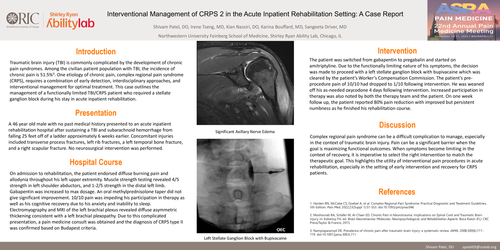
Due to this complicated presentation, a pain medicine consult was obtained and the diagnosis of CRPS type II was confirmed based on Budapest criteria. He was switched from gabapentin to pregabalin and started on amitriptyline. Due to the functionally limiting nature of his symptoms, the decision was made to proceed with a left stellate ganglion block with bupivacaine which was cleared by the patient’s Worker’s Compensation Commission. The patient’s pre-procedure pain of 10/10 had dropped to 1/10 following intervention. He was weaned off his as-needed oxycodone 4 days following intervention. Increased participation in therapy was also noted by both the therapy team and the patient. On one week follow up, the patient reported 80% pain reduction with improved but persistent numbness as he finished his rehabilitation course.
Discussion
Complex regional pain syndrome can be a difficult complication to manage, especially in the context of traumatic brain injury. Pain can be a significant barrier when the goal is maximizing functional outcomes. When symptoms become limiting in the context of recovery, it is imperative to select the right intervention to match the therapeutic goal. This highlights the utility of interventional pain procedures in acute rehabilitation, especially in the setting of early intervention and recovery for CRPS patients.
References
1. Harden RN, McCabe CS, Goebel A, et al. Complex Regional Pain Syndrome: Practical Diagnostic and Treatment Guidelines, 5th Edition. Pain Med. 2022;23(Suppl 1):S1-S53. doi:10.1093/pm/pnac046
2. Moshourab RA, Schäfer M, Al-Chaer ED. Chronic Pain in Neurotrauma: Implications on Spinal Cord and Traumatic Brain Injury. In: Kobeissy FH, ed. Brain Neurotrauma: Molecular, Neuropsychological, and Rehabilitation Aspects. Boca Raton (FL): CRC Press/Taylor & Francis; 2015.
3. Nampiaparampil DE. Prevalence of chronic pain after traumatic brain injury: a systematic review. JAMA. 2008;300(6):711-719. doi:10.1001/jama.300.6.711