425 posters, 1 videos, 9 audios, 8 topics, 53 sessions, 340 authors, 286 institutions
ePostersLive by SciGen Technologies S.A. All rights reserved.
22nd Annual Pain Medicine Meeting 2023
November 10 - 11, 2023 | New Orleans Marriott | New Orleans, Louisiana, USA

4735
ULTRASOUND-GUIDED SPINAL ANESTHESIA IN A PATIENT WITH A DORSAL ROOT GANGLION STIMULATOR AND CHRONIC REGIONAL PAIN SYNDROME
Poster Presenter
Authors
Affiliations
Part of Topic
Medically Challenging Cases
Ultrasound-guided spinal anesthesia in a patient with a dorsal root ganglion stimulator and chronic regional pain syndrome
Jessica Anyaso, M.D.; Michael Gwede, M.D.; Alexander Foster, M.D.; Caroline Thomas, M.D.; J. Thomas Xiao, M.D. Department of Anesthesia and Critical Care, University of Chicago Medical Center: Chicago, Illinois, United States of America
Dorsal root ganglion (DRG) stimulators are commonly used in the alleviation of chronic pain states. Limited information on neuraxial anesthetic management techniques for patients with complex regional pain syndrome (CRPS) and in-situ dorsal root ganglion stimulators exist. Here, we discuss the case of a patient with CRPS with an in-situ DRG stimulator who underwent a successful spinal anesthetic for obstetric care in an alternative interspinous space.
-
29 year-old G2P1; prior C-section for first child
-
Presented to labor/delivery for repeat C- section
-
History of CRPS type 1 and chronic opioid use
-
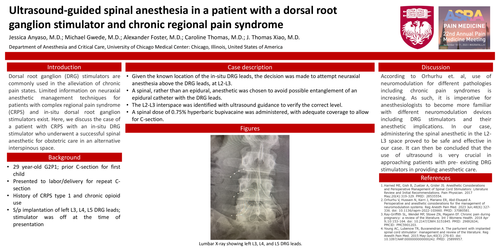
S/pimplantationofleftL3,L4,L5DRGleads; stimulator was off at the time of presentation
-
•Given the known location of the in-situ DRG leads, the decision was made to attempt neuraxial anesthesia above the DRG leads, at L2-L3.•A spinal, rather than an epidural, anesthetic was chosen to avoid possible entanglement of an epidural catheter with the DRG leads.•The L2-L3 interspace was identified with ultrasound guidance to verify the correct level.•A spinal dose of 0.75% hyperbaric bupivacaine was administered, with adequate coverage to allow for C-section.
-
According to Orhurhu et. al, use of neuromodulation for different pathologies including chronic pain syndromes is increasing. As such, it is imperative for anesthesiologists to become more familiar with different neuromodulation devices including DRG stimulators and their anesthetic implications. In our case, administering the spinal anesthetic in the L2-L3 space proved to be safe and effective in our case. It can then be concluded that the use of ultrasound is very crucial in approaching patients with pre- existing DRG stimulators in providing anesthetic care.