425 posters, 1 videos, 9 audios, 8 topics, 53 sessions, 340 authors, 286 institutions
ePostersLive by SciGen Technologies S.A. All rights reserved.
22nd Annual Pain Medicine Meeting 2023
November 10 - 11, 2023 | New Orleans Marriott | New Orleans, Louisiana, USA

4581
ULTRASOUND-GUIDED PERIPHERAL NERVE BLOCK OF COMMON PERONEAL NERVE FOR BELOW-KNEE RESIDUAL LIMB PAIN
Poster Presenter
Authors
Affiliations
Part of Topic
Medically Challenging Cases
Introduction
In lower limb amputees that experience pain, femoral and sciatic nerve blocks have been used in managing discomfort and quality of life. These nerve blocks are a part of a multimodal pain management approach that aims to reduce reliance on pharmacologic treatment and minimize pain. Common peroneal nerve blocks are rare and not often cited in the literature.
The following case involves a 77-year-old female patient searching for treatment due to left residual limb pain, stemming from an amputation carried out two years prior. This case report delves into the patient's journey, discussing her pain experience and showcases the decision to perform a peripheral nerve block to the common peroneal nerve using ultrasound-guided techniques.
Material and Methods
Patient informed verbal consent was obtained for submission of a case report. Description of the photos, text, and chart was explained to the patient. The material will be published without the patient’s name attached and it was explained to the patient that practitioners will not receive any financial benefit from publication of this abstract. Consent was obtained securely and in confidence.
Results / Case Report
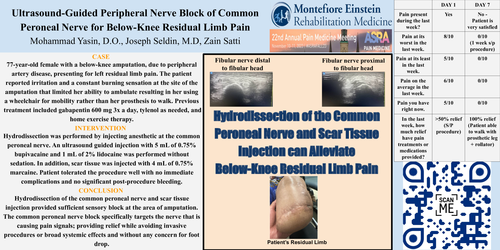
A 77-year old female with a medical history of atrial fibrillation, diabetes mellitus, hypertension, and a below-knee amputation presented to the clinic for left residual limb pain. The amputation occurred 2 years prior due to peripheral artery disease. The surgery performed was a femoral artery bypass with a guillotine below-knee amputation with closure. The current treatment regimen for the patient included gabapentin 600 mg 3x a day, tylenol as needed, and home exercise therapy. The patient had irritation and a constant burning sensation at the site of the amputation that limited her ability to ambulate and was using a wheelchair for mobility. In addition, the patient was receiving warfarin for anticoagulation, and Prothrombin Time (PT) and International Normalized Ratio (INR) were drawn on the day of the procedure.
After discussion with and consent from the patient, it was decided that a hydrodissection would be performed by injecting anesthetic at the common peroneal nerve. The patient was placed in a supine position and under sterile conditions an ultrasound guided injection with 5 mL of 0.75% bupivacaine and 1 mL of 2% lidocaine was performed without sedation. The ultrasound utilized for this procedure was a Sonosite HFL50xp, complemented by a linear array transducer type. Sufficient sensory block at the area of amputation was obtained, and the patient's vital signs were stable during the procedure. Patient tolerated the procedure well with no immediate complications and no significant post-procedure bleeding. Scar tissue was injected with 4 mL of 0.75% marcaine.
Discussion
Although cases of hydrodissection targeting the peroneal nerve are relatively limited in the literature, the technique has exhibited success in addressing various neuropathies. The common peroneal nerve's substantial role in lower leg and foot innervation is involved in the motor function of gait, hence why it is not commonly blocked in healthy patients. The intricate anatomy and potential complications that may result from this procedure have been a reason for its limited utilization. Complications include foot drop and a loss of sensory function in the common peroneal nerve region.
In this case, given that the motor component of this nerve was not necessary due to the amputation, it was decided to proceed with the procedure. This case highlights the execution of a unique procedure that yielded significant relief. Many procedures and approaches may be used in a situation such as this one, where a post-amputation patient is suffering from RLP. Common alternatives include local anesthetic infiltration, neuroma resection, and epidural analgesia. However, in this case, the decision to pursue a common peroneal nerve block was due to its potential to offer a comprehensive solution. The common peroneal nerve block specifically targets the nerve that is causing pain signals, providing relief while avoiding invasive procedures or broad systemic effects.