425 posters, 1 videos, 9 audios, 8 topics, 53 sessions, 340 authors, 286 institutions
ePostersLive by SciGen Technologies S.A. All rights reserved.
22nd Annual Pain Medicine Meeting 2023
November 10 - 11, 2023 | New Orleans Marriott | New Orleans, Louisiana, USA

4560
A COMPLEX ANTICOAGULATION PLAN & LUMBAR INTERLAMINAR EPIDURAL STEROID INJECTION IN A PATIENT WITH A LVAD
Poster Presenter
Authors
Affiliations
Part of Topic
Medically Challenging Cases
TITLE: A Complex Anticoagulation Plan & Lumbar Interlaminar Epidural Steroid Injection in a Patient with a Left Ventricular Assist Device (LVAD) – A Case Report
AUTHORS & AFFILIATIONS: Trishul Kapoor MD1, Richard Rosenquist MD1
- Department of Pain Management, Cleveland Clinic, Cleveland, OH
INTRODUCTION
As of 2016, the prevalence of adults living with heart failure was estimated to be over 6.2 million.1 Once a diagnosis of heart failure is made, nearly 50% of patients die within 5 years and 90% of patients die within 10 years.1 The complexity of clinical care increases exponentially when heart failure and chronic pain co-exist.2 Unfortunately, this co-existence is increasing in prevalence.2 Patients with heart failure and chronic pain are remarkably challenging to provide therapeutic analgesic relief to due to drug-drug interactions and interference with heart failure management.2,3 It has been demonstrated that inadequate pain control can lead to poor quality of life, increased hospitalizations, and decreased survival.2,3 However, to the best of our knowledge, there is no literature describing the role of interventional pain procedures in heart failure patients and management of anticoagulation regimens. In this medically challenging case report, we describe a 71-year-old male with chronic systolic heart failure with a presumed destination therapy left ventricular assist device (LVAD), on anticoagulation, who underwent a lumbar interlaminar epidural steroid injection. The anticoagulation plan for this patient was carefully constructed in discussion with a multi-disciplinary team based on ASRA Anticoagulation Guidelines and characteristics of his Heartmate 3 LVAD.
METHODS
A retrospective chart review of one patient was conducted in 2023. This study was determined to be exempt from Institutional Review Board at the Cleveland Clinic. The participant described in this study provided informed consent to be included in this case report.
RESULTS
In 2022, a 71-year-old male was referred to the Cleveland Clinic Pain Management Center (PMC) for chronic severe non-radiating lower and mid-back pain. The patient’s medical history is significant for chronic systolic heart failure with a presumed destination-therapy LVAD and an implantable cardioverter-defibrillator (ICD) requiring anticoagulation with warfarin (target INR of 2.5). He was pacemaker-dependent (DDDR, target heart rate of 80 to 120) and recently had an ICD-delivered shock for atrial arrythmia. In addition, he also had a history of valvular heart disease status post aortic and mitral valve bioprosthetic replacement, chronic kidney disease (stage 3), and atrial fibrillation status post left atrial appendage clip. He has a past surgical history significant for L5 left hemi-laminectomy 35 years ago. The patient was referred to the PMC in the hope of tapering his high dose opioid regimen in preparation for possible heart transplant candidacy.
On initial evaluation, the patient presented with severe non-radiating lower and mid-back pain that was exacerbated by standing and walking. He had moderate relief of pain with sitting and forward-flexion. The patient had minimal analgesic relief with multiple opioid prescriptions (54.5 to 218 MME per day) over the course of two years and undergone multiple procedures, described below, over the course of 6 years leading to his LVAD implant placement.
2021 – Uncomplicated right and left lumbar facet medial nerve block at L4, L5, S1 (0.8 ml of 1% Lidocaine and 7mg of Triamcinolone per site). Prior the procedure, the patient was on Rivaroxaban and did not hold his anticoagulation prescription for the procedure. He had 30% relief for 24 hours with this procedural intervention.
2018 – Uncomplicated right and left lumbar facet medial branch bipolar radiofrequency ablation at L3, L4, L5 in 2018. He had 30% relief for 3 months.
2017 – Uncomplicated left lumbar facet medial branch pulsed radiofrequency ablation at L3, L4, L5 and right lumbar medial branch blocks at L3, L4, L5 (0.5 ml of 1% Lidocaine per site) in 2017. He had 50% relief for 7 months.
2016 – Uncomplicated left lumbar facet medial branch pulsed radiofrequency ablation at L3, L4, L5 and right lumbar medial branch blocks at L3, L4, L5 (0.5 ml of 1% Lidocaine with 13mg of Triamcinolone per site) in 2016. He had unspecified percentage of relief for 3 months and this procedure was repeated once again in 2016.
His home medications included Oxycodone 15mg 1-4 times per day (22.5 to 90.0 MME per day), Hydromorphone 8mg 1-4 times per day (32 to 128 MME per day), Methocarbamol 1000mg BID, and Duloxetine 40mg daily. On physical exam, he had moderate tenderness to palpation over the lower thoracic and lumbar paraspinal muscles. Pain was elicited with back extension and lateral extension. Straight leg raising test was positive. He had decreased sensation to touch on the medial aspect of the right and left foot (heel to great toe). He demonstrated symmetric right and left, upper and lower extremity strength.
He previously had an MRI of the lumbar spine completed in 2020. The scan demonstrated a 1.3 cm left lateral subluxation of L3 on L4 with severe loss of disc height at L3-L4 and L5-S1. There was significant hypertrophy of the ligamentum flavum (measuring 5.2mm) at L4-L5. Furthermore, at L2-L3, L3-L4, L4-L5, there was moderate central canal and neuroforaminal (right and left) stenosis due disc osteophyte complex, broad-based disc bulge, endplate hypertrophy, and hypertrophic changes in the facet joints. There was no evidence of focal protrusion, extrusion, or sequestration. As a follow-up, he underwent a CT of the lumbar spine in 2022. The scan demonstrated progression to severe right and left neuroforaminal narrowing at L2-L3, L3-L4, L4-L5, L5-S1.
The patient was instructed to hold his warfarin 5 days prior to the scheduled procedure and begin therapeutic enoxaparin injections, twice daily, until 24 hours prior to the scheduled procedure. An interlaminar epidural steroid injection (IESI) was attempted at the L3-L4 interspace, but was unsuccessful due to severe dystrophic interlaminar calcification in the setting of scoliotic torsion. The patient underwent a successful and uncomplicated L2-L3 IESI with a mixture of 40mg of preservative-free methylprednisolone and normal saline. The patient had no evidence of epidural hematoma, cerebrospinal fluid leak, or LVAD malfunction. The patient was instructed to resume his enoxaparin injections and warfarin 24 hours following the procedural intervention. The patient was contacted 5 days after the procedure and reported having 75% analgesic relief as a result of the L2-L3 IESI.
CONCLUSION
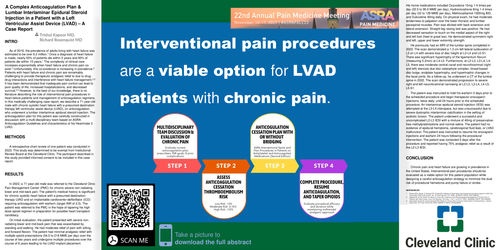
Chronic pain and heart failure are growing in prevalence in the United States. Interventional pain procedures should be evaluated as a viable option for this patient population while designing a careful anticoagulation strategy to minimize the dual risk of procedural hematoma and pump failure or stroke.
REFERENCES:
- Bowen RES, Graetz TJ, Emmert DA, Avidan MS. Statistics of heart failure and mechanical circulatory support in 2020. Ann Transl Med. 2020 Jul;8(13):827. doi: 10.21037/atm-20-1127. PMID: 32793672; PMCID: PMC7396255.
- Majeed MH, Ali AA, Khalil HA, Bacon D, Imran HM. A Review of the Pharmacological Management of Chronic Pain in Patients with Heart Failure. Innov Clin Neurosci. 2019 Nov 1;16(11-12):25-27. PMID: 32082939; PMCID: PMC7006868.
- Alemzadeh-Ansari MJ, Ansari-Ramandi MM, Naderi N. Chronic Pain in Chronic Heart Failure: A Review Article. J Tehran Heart Cent. 2017 Apr;12(2):49-56. PMID: 28828019; PMCID: PMC5558055.