425 posters, 1 videos, 9 audios, 8 topics, 53 sessions, 340 authors, 286 institutions
ePostersLive by SciGen Technologies S.A. All rights reserved.
22nd Annual Pain Medicine Meeting 2023
November 10 - 11, 2023 | New Orleans Marriott | New Orleans, Louisiana, USA

5007
SPINAL CORD STIMULATION IN A PATIENT WITH HEMOPHILIA C
Poster Presenter
Authors
Affiliations
Part of Topic
Medically Challenging Cases
Introduction
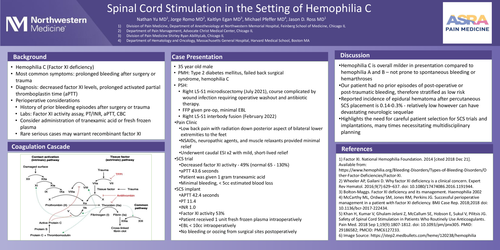
Factor XI (FXI) deficiency, otherwise known as hemophilia C, is an autosomal recessive bleeding disorder that affects an estimated 1 in 100,000 individuals, with predominant occurrence in the Ashkenazi Jewish population.(1) The most common signs and symptoms of FXI deficiency are prolonged bleeding following surgery or trauma. Diagnosis is made via decreased serum factor XI levels, which typically manifests as a prolonged activated partial thromboplastin time (aPTT).(2) Patients with hemophilia C have a more variable bleeding tendency than hemophilia A or B and typically do not require outpatient treatment unless with severe deficiency. (3) However, in the perioperative period there are special considerations that are necessary. Patients with hemophilia C require advanced surgical planning and preoperative testing to determine the extent of their disease - including coagulation labs (PT, aPTT), factor XI activity assays, and complete blood counts. Antifibrinolytic agents, such as tranexamic acid (TXA),are often used in the perioperative setting as both prophylaxis and treatment of excessive bleeding. Fresh frozen plasma (FFP) is also commonly used to treat patients preoperatively, and in very specific cases recombinant Factor XI can be considered if available.(3)
Chronic pain affects patients with a wide range of comorbidities including coagulopathies. Gaining more understanding of patients with bleeding disorders and their disease processes can improve the overall safety and efficacy of the treatments we provide them. Although the reported incidence of epidural hematoma after percutaneous spinal cord stimulator (SCS) placement is relatively low at 0.14-0.3% (4), the neurologic sequelae can be devastating - which is why it is crucial to have an understanding of the risks of performing SCS in patients with bleeding disorders.
Case Summary
The patient is a 35 year old male with a medical history significant for type 2 diabetes mellitus, failed back surgical syndrome, and hemophilia C. His initial injury occurred in 2020 when he fell while attempting to lift a heavy weight, which caused sudden excruciating low back and leg pain. He initially attempted conservative management with physical therapy, medications, and lumbar epidural steroid injections, which provided minimal relief. He underwent a right L5-S1 microdiscectomy in July 2021, with a course complicated by wound infection requiring operative washout and antibiotic therapy. Following the microdiscectomy, his pain did not resolve, and he proceeded to undergo an L5-S1 interbody fusion in February 2022. This procedure provided relief however his pain returned shortly afterwards. He was then referred to our pain clinic for further management.
His pain on presentation was in the low back with radiation to the bilateral lower extremities. His baseline pain score was 9/10. He reported constant low back pain with intermittent radiating
symptoms down the posterior lower extremities to the feet. His medications at that time were celecoxib, cyclobenzaprine, and pregabalin, which provided him mild relief. He underwent two caudal epidural steroid injections, the first of which provided greater than 70% pain relief for several days. The second injection provided good relief for a month. Despite this, the patient desired more prolonged pain relief and was amenable to proceeding with the SCS trial.
Hematology was consulted in the setting of the patient’s known history of Hemophilia C. Prior labs demonstrated a decreased factor XI activity of 49% (normal 65 - 130%) and a slightly prolonged aPTT of 43.6 seconds. Per discussion with hematology, the risk of significant bleeding in this patient was extremely low given that he does not have a history of bleeding events and has tolerated prior surgeries and neuraxial techniques. They did not feel strongly that blood product administration was warranted prior to the procedure, however they did mention consideration of tranexamic acid administration preoperatively.
During the SCS trial, the patient received 1 gram of TXA. Overall the procedure was uncomplicated with an estimated blood loss (EBL) of 5 cc. Following the trial, the patient reported significant improvement in his pain and decided to proceed with a permanent implant.
In preparation for surgery, the patient was seen by the anesthesiology preoperative clinic. The patient had multiple labs drawn. His aPTT was stable from prior at 42.4, PT-INR was normal at 11.4 and 1.0, respectively, and factor XI activity was 53%. Per discussion with hematology, they recommended preoperative transfusion of fresh frozen plasma (FFP).
On the day of the surgery, the patient received 1 unit of FFP preoperatively. The SCS implantation was uncomplicated with an EBL of less than 10 cc. His postoperative course was unremarkable, with no bleeding from the surgical sites.
Discussion
There is an understandable lack of literature surrounding SCS trials/implantations in patients with factor deficiencies and other coagulopathies. Hemophilia C has an overall milder presentation than those of hemophilias A and B, and is not prone to spontaneous bleeding and hemarthroses. Despite this, careful preoperative investigation is warranted - as was the case with our patient. Our multidisciplinary approach involved the surgical team, anesthesiology, and input from hematology. We were fortunate that his factor XI activity was only mildly decreased and that he had undergone other invasive surgeries without any significant hemorrhagic events.
This case is one demonstration that proper patient selection is crucial in determination of candidacy for spinal cord stimulation. Furthermore, overall management of patients with hemophilia C and other complex bleeding disorders should involve a multidisciplinary approach.