425 posters, 1 videos, 9 audios, 8 topics, 53 sessions, 340 authors, 286 institutions
ePostersLive by SciGen Technologies S.A. All rights reserved.
22nd Annual Pain Medicine Meeting 2023
November 10 - 11, 2023 | New Orleans Marriott | New Orleans, Louisiana, USA

5000
ACUTE ON CHRONIC PAIN MANAGEMENT OF RECURRENT MOREL LAVALLÉE LESIONS
Poster Presenter
Authors
Affiliations
Part of Topic
Medically Challenging Cases
Medically Challenging Case: Acute on Chronic Pain Management of Recurrent Morel Lavallée Lesions
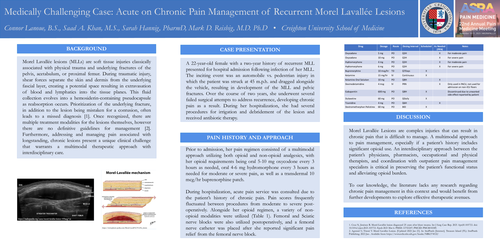
Morel Lavallée lesions (MLLs) are soft tissue injuries classically associated with physical trauma and underlying fractures of the pelvis, acetabulum, or proximal femur. During traumatic injury, shear forces separate the skin and dermis from the underlying fascial layer, creating a potential space resulting in extravasation of blood and lymphatics into the tissue planes. This fluid collection evolves into a hemosiderin-containing pseudocapsule as reabsorption occurs. Prioritization of the underlying fracture, in addition to the lesion being mistaken for a contusion, often leads to a missed diagnosis [1]. Once recognized, there are multiple treatment modalities for the lesions themselves, however there are no definitive guidelines for management [2]. Furthermore, addressing and managing pain associated with longstanding, chronic lesions present a unique clinical challenge that warrants a multimodal therapeutic approach with interdisciplinary care.
A 22-year-old female with a two-year history of recurrent MLL presented for hospital admission following infection of her MLL. The inciting event was an automobile vs. pedestrian injury in which the patient was struck at 45 m.p.h. and dragged alongside the vehicle, resulting in development of the MLL and pelvic fractures. Over the course of two years, she underwent several failed surgical attempts to address recurrence, developing chronic pain as a result. During her hospitalization, she had several procedures for irrigation and debridement of the lesion and received antibiotic therapy.
Prior to admission, her pain regimen consisted of a multimodal approach utilizing both opioid and non-opioid analgesics, with her opioid requirements being oral 5-10 mg oxycodone every 3 hours as needed, oral 4-6 mg hydromorphone every 3 hours as needed for moderate or severe pain, as well as a transdermal 10 mcg/hr buprenorphine patch.
During hospitalization, acute pain service was consulted due to the patient’s history of chronic pain. Pain scores frequently fluctuated between procedures from moderate to severe post-operatively. Alongside her opioid regimen, a variety of non-opioid modalities were utilized (Table 1). Femoral and Sciatic nerve blocks were also utilized postoperatively, and a femoral nerve catheter was placed after she reported significant pain relief from the femoral nerve block.
Morel Lavallée Lesions are complex injuries that can result in chronic pain that is difficult to manage. A multimodal approach to pain management, especially if a patient’s history includes significant opioid use. An interdisciplinary approach between the patient’s physicians, pharmacists, occupational and physical therapists, and coordination with outpatient pain management specialists is critical in preserving the patient’s functional status and alleviating opioid burden.
To our knowledge, the literature lacks any research regarding chronic pain management in this context and would benefit from further developments to explore effective therapeutic avenues.