425 posters, 1 videos, 9 audios, 8 topics, 53 sessions, 340 authors, 286 institutions
ePostersLive by SciGen Technologies S.A. All rights reserved.
22nd Annual Pain Medicine Meeting 2023
November 10 - 11, 2023 | New Orleans Marriott | New Orleans, Louisiana, USA

4892
INFECTION FOLLOWING SPINAL CORD STIMULATOR TRIAL: A CASE REPORT AND LITERATURE REVIEW
Poster Presenter
Authors
Affiliations
Part of Topic
Medically Challenging Cases
•Spinal Cord Stimulators (SCS) have been implicated in the treatment and management of multiple chronic pain syndromes
•The incidence of complications, namely infections, is reported as 2-14% of SCS implanted1.
•This poses significant clinical concern for the patient, as infection is associated with hospitalization, surgical intervention, and long-term antibiotics2.
•Here, we report the case of a 78-year-old man who underwent an SCS trial and subsequently developed an infection soon after. We will review the literature regarding SCS infection rates in both trials and permanent implants- along with identification, prevention, and management.
•78-year-old man with a history of coronary artery disease with stents (on clopidogrel), heart failure with an implantable cardioverter defibrillator, and prior L3-L5 posterior spinal fusion who presented with chronic low back pain
•Pain: severe, sharp, and radiated into his right lower extremity that did not respond to conservative therapy and injections
•Underwent a 7-day percutaneous SCS trial
•Presented after 1 week to the ED with severe low back pain and an episode of bowel incontinence
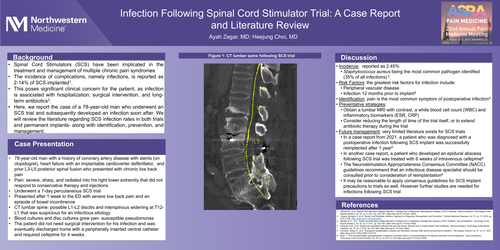
•CT lumbar spine: possible L1-L2 discitis and interspinous widening at T12-L1 that was suspicious for an infectious etiology
•Blood cultures and disc cultures grew pan- susceptible pseudomonas
•The patient did not need surgical intervention for his infection and was eventually discharged home with a peripherally inserted central catheter and required cefepime for 4 weeks
•Incidence: reported as 2.45%
•Staphylococcus aureus being the most common pathogen identified (35% of all infections) 3.
•Risk Factors: the greatest risk factors for infection include:
•Peripheral vascular disease
•Infection 12 months prior to implant4
•Identification: pain is the most common symptom of postoperative infection4
•Preventative strategies:
•Obtain a lumbar MRI with contrast, a white blood cell count (WBC) and inflammatory biomarkers (ESR, CRP)
•Consider reducing the length of time of the trial itself, or to extend antibiotic therapy during the trial
•Future management: very limited literature exists for SCS trials
•In a case report from 2021, a patient who was diagnosed with a postoperative infection following SCS implant was successfully reimplanted after 1 year5
•In another case report, a patient who developed an epidural abscess following SCS trial was treated with 6 weeks of intravenous cefepime6
•The Neurostimulation Appropriateness Consensus Committee (NACC) guidelines recommend that an infectious disease specialist should be consulted prior to consideration of reimplantation6
•It may be reasonable to apply consensus guidelines for SCS implant precautions to trials as well. However further studies are needed for infections following SCS trial
1. Bendel, M., et al. “Spinal Cord Stimulator Related Infections: Findings from a Multicenter Retrospective Analysis of 2737 Implants.” Neuromodulation: Technology at the Neural Interface, vol. 20, no. 6, 2017, pp. 553–557, https://doi.org/10.1111/ner.12636.
2. Esquer Garrigos, Z, et al. “Spinal Cord Stimulator Infection: Approach to Diagnosis, Management, and Prevention.” Clinical Infectious Diseases, vol. 70, no. 12, 2019, pp. 2727–2735, https://doi.org/10.1093/cid/ciz994.
3.Bendel, M A., et al. “Spinal cord stimulator related infections: Findings from a multicenter retrospective analysis of 2737 implants.” Neuromodulation: Technology at the Neural Interface, vol. 20, no. 6, 2017, pp. 553–557, https://doi.org/10.1111/ner.12636.
4.Falowski, S M., et al. “Spinal cord stimulation infection rate and risk factors: Results from a United States Payer Database.” Neuromodulation: Technology at the Neural Interface, vol. 22, no. 2, 2019, pp. 279–289, https://doi.org/10.1111/ner.12843.
5.Schwartz, Ruben H., et al. “Successful reimplantation of spinal cord stimulator one year after device removal due to infection.” The Surgery Journal, vol. 07, no. 01, 2021, https://doi.org/10.1055/s-0040-1722179.
6.Deer, T. “The neurostimulation appropriateness consensus committee (NACC) recommendations for infection prevention and management.” Neuromodulation: Technology at the Neural Interface, vol. 20, no. 5, 2017, p. 516, https://doi.org/10.1111/ner.12635.