425 posters, 1 videos, 9 audios, 8 topics, 53 sessions, 340 authors, 286 institutions
ePostersLive by SciGen Technologies S.A. All rights reserved.
22nd Annual Pain Medicine Meeting 2023
November 10 - 11, 2023 | New Orleans Marriott | New Orleans, Louisiana, USA

4869
CASE SERIES ON USING INSULIN PEN FOR FACIAL NERVE BLOCKS FOR PAIN MANAGEMENT
Poster Presenter
Authors
Affiliations
Part of Topic
Medically Challenging Cases
Case Series On Using Insulin
Pen For Facial Nerve Blocks
For Pain Management
INTRODUCTION
DISCUSSION
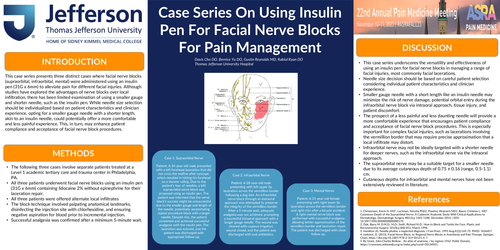
This case series presents three distinct cases where facial nerve blocks
(supraorbital, infraorbital, mental) were administered using an insulin
pen (31G x 6mm) to alleviate pain for different facial injuries. Although
studies have explored the advantages of nerve blocks over local
infiltration, there has been limited examination of using a smaller gauge
and shorter needle, such as the insulin pen. While needle size selection
should be individualized based on patient characteristics and clinician
experience, opting for a smaller gauge needle with a shorter length,
akin to an insulin needle, could potentially offer a more comfortable
and less painful experience. This, in turn, may enhance patient
compliance and acceptance of facial nerve block procedures.
Davis Cho DO, Bernice Yu DO, Gustin Reynolds MD, Rabiul Ryan DO
Thomas Jefferson University Hospital
• The following three cases involve separate patients treated at a
Level 1 academic tertiary care and trauma center in Philadelphia,
PA.
• All three patients underwent facial nerve blocks using an insulin pen
(31G x 6mm) containing lidocaine 2% without epinephrine for their
laceration repair.
• All three patients were offered alternate local infiltrates
• The block technique involved palpating anatomical landmarks,
disinfecting the injection site with chlorhexidine, and ensuring
negative aspiration for blood prior to incremental injection.
• Successful analgesia was confirmed after a minimum 5-minute wait.
METHODS
• This case series underscores the versatility and effectiveness of
using an insulin pen for facial nerve blocks in managing a range of
facial injuries, most commonly facial lacerations.
• Needle size decision should be based on careful patient selection
considering individual patient characteristics and clinician
experience.
• Smaller gauge needle with a short length like an insulin needle may
minimize the risk of nerve damage, potential orbital entry during the
infraorbital nerve block via intraoral approach, tissue injury, and
patient discomfort.
• The prospect of a less painful and less daunting needle will provide a
more comfortable experience that encourages patient compliance
and acceptance of facial nerve block procedures. This is especially
important for complex facial injuries, such as lacerations involving
the vermillion border that may require precise approximation that a
local infiltrate may distort.
• Infraorbital nerve may not be ideally targeted with a shorter needle
for deeper nerves, such as the infraorbital nerve via the intraoral
approach.
• The supraorbital nerve may be a suitable target for a smaller needle
due to its average cutaneous depth of 0.75 ± 0.16 (range, 0.5-1.1)
cm.
• Cutaneous depths for infraorbital and mental nerves have not been
extensively reviewed in literature.
Case 1: Supraorbital Nerve
Patient: A 34-year-old male presented
with a left forehead laceration that did
not cross the midline after syncope,
which resulted in hitting his forehead
on a shower railing. Due to the
patient's fear of needles, a left
supraorbital nerve block was
proposed using an insulin pen. The
patient was informed that the nerve
block's success might be unsuccessful
due to the smaller gauge and length of
the needle, potentially necessitating
repeat procedure block with a larger
needle. Despite this, the patient
consented and achieved successful
analgesia with the insulin pen. The
laceration was sutured, and the
patient was discharged with
appropriate follow-up.
Case 2: Infraorbital Nerve
Patient: A 28-year-old male
presenting with left upper lip
laceration across the vermillion border
following a dog bite. An infraorbital
nerve block through an extraoral
approach was attempted to preserve
the integrity of the vermillion border.
After a 5-minute wait, adequate
analgesia was not achieved, prompting
a successful intraoral approach with a
longer gauge needle. The wound was
cleaned with copious irrigation,
wound closed, and the patient was
discharged with oral antibiotics.
Case 3: Mental Nerve
Patient: A 21-year-old female
presenting with right lower lip
laceration across the vermillion border
and right chin after a bicycle accident.
A right mental nerve block was
performed with successful analgesia
allowing better approximation of the
vermillion border and laceration repair.
The patient was discharged with close
follow up.
References
1. Christensen, Kevin N. MD*; Lachman, Nirusha PhD†; Pawlina, Wojciech MD†; Baum, Christian L. MD*.
Cutaneous Depth of the Supraorbital Nerve: A Cadaveric Anatomic Study With Clinical Applications to
Dermatology. Dermatologic Surgery 40(12):p 1342-1348, December 2014. | DOI:
10.1097/DSS.0000000000000174
2. Zide, Barry M. D.M.D., M.D.; Swift, Richard M.D.. How to Block and Tackle the Face. Plastic and
Reconstructive Surgery 101(3):p 840-851, March 1998.
3. Hamilton JG. Needle phobia: a neglected diagnosis. J Fam Pract. 1995 Aug;41(2):169-75. PMID: 7636457.
4. Jankovic, D. (2015). Facial Nerve Block. In: Regional Nerve Blocks in Anesthesia and Pain Therapy. Springer,
Cham. https://doi.org/10.1007/978-3-319-05131-4_7
5. By Grant, John Charles Boileau - An atlas of anatomy, / by regions 1962, Public Domain,
https://commons.wikimedia.org/w/index.php?curid=30134901