425 posters, 1 videos, 9 audios, 8 topics, 53 sessions, 340 authors, 286 institutions
ePostersLive by SciGen Technologies S.A. All rights reserved.
22nd Annual Pain Medicine Meeting 2023
November 10 - 11, 2023 | New Orleans Marriott | New Orleans, Louisiana, USA

4772
STIFF PERSON SYNDROME: A CASE REPORT
Poster Presenter
Part of Topic
Medically Challenging Cases
Stiff Person Syndrome: A Case Report
Alexander Mounts, DO1; Alexander Kreger, MS42; Shahira Khoury, MD1
1. Department of Physical Medicine and Rehabilitation, University of California Irvine
2. University of California Irvine School of Medicine
Background:
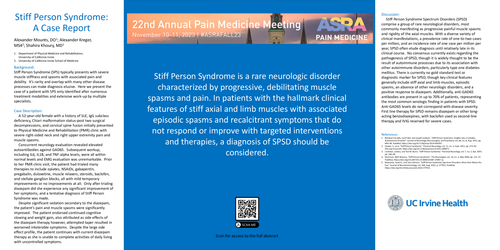
Stiff Person Syndrome (SPS) typically presents with severe muscle stiffness and spasms with associated pain and debility. It’s rarity and overlap with many other disease processes can make diagnosis elusive. Here we present the case of a patient with SPS only identified after numerous treatment modalities and extensive work-up by multiple specialists.
Case Description:
A 52-year-old female with a history of SLE, IgG subclass deficiency, Chiari malformation status-post two surgical decompressions, and cervical spine fusion initially presented to Physical Medicine and Rehabilitation (PMR) clinic with severe right-sided neck and right upper extremity pain and muscle spasms.
Concurrent neurology evaluation revealed elevated autoantibodies against GAD65. Subsequent workup, including IL6, IL1B, and TNF-alpha levels, were all within normal levels and EMG evaluation was unremarkable. Prior to her PMR clinic visit, the patient had trialed many therapies to include opiates, NSAIDs, gabapentin, pregabalin, duloxetine, muscle relaxers, steroids, baclofen, and stellate ganglion blocks, all with mild temporary improvements or no improvements at all. Only after trialing diazepam did she experience any significant improvement of her symptoms, and a tentative diagnosis of Stiff Person Syndrome was made.
Despite significant sedation secondary to the diazepam, the patient’s pain and muscle spasms were significantly improved. The patient endorsed continued cognitive slowing and weight gain, also attributed as side effects of the diazepam therapy however, attempted taper resulted in worsened intolerable symptoms. Despite the large side effect profile, the patient continues with current diazepam therapy as she is unable to complete activities of daily living with uncontrolled symptoms.
Discussion:
Stiff Person Syndrome Spectrum Disorders (SPSD) comprise a group of rare neurological disorders, most commonly manifesting as progressive painful muscle spasms and rigidity of the axial muscles. With a diverse variety of clinical manifestations, a prevalence rate of one-to-two cases per million, and an incidence rate of one case per million per year, SPSD often elude diagnosis until relatively late in its clinical course. No consensus currently exists regarding the pathogenesis of SPSD, though it is widely thought to be the result of autoimmune processes due to its association with other autoimmune disorders, particularly type one diabetes mellitus. There is currently no gold standard test or diagnostic marker for SPSD, though key clinical features generally include stiff axial and limb muscles, episodic spasms, an absence of other neurologic disorders, and a positive response to diazepam. Additionally, anti-GAD65 antibodies are present in up to 70% of patients, representing the most common serologic finding in patients with SPSD. Anti-GAD65 levels do not correspond with disease severity. First line therapy for SPSD remains diazepam or other long-acting benzodiazepines, with baclofen used as second-line therapy and IVIG reserved for severe cases.
Stiff Person Syndrome is a rare neurologic disorder characterized by progressive, debilitating muscle spasms and pain. In patients with the hallmark clinical features of stiff axial and limb muscles with associated episodic spasms and recalcitrant symptoms that do not respond or improve with targeted interventions and therapies, a diagnosis of SPSD should be considered.
References: