425 posters, 1 videos, 9 audios, 8 topics, 53 sessions, 340 authors, 286 institutions
ePostersLive by SciGen Technologies S.A. All rights reserved.
22nd Annual Pain Medicine Meeting 2023
November 10 - 11, 2023 | New Orleans Marriott | New Orleans, Louisiana, USA

4692
DORSAL ROOT GANGLION (DRG) STIMULATOR FOR THE TREATMENT OF SINUS TARSI SYNDROME.
Poster Presenter
Authors
Affiliations
Part of Topic
Medically Challenging Cases
BACKGROUND:
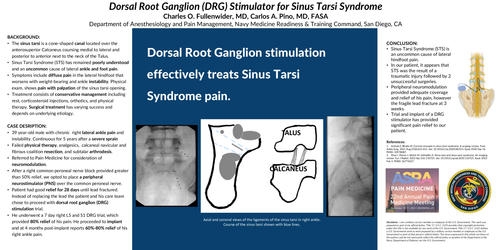
- The sinus tarsi is a cone-shaped canal located over the
anterosuperior Calcaneus coursing medial to lateral and
posterior to anterior next to the neck of the Talus.
- Sinus Tarsi Syndrome (STS) has remained poorly understood
and an uncommon cause of lateral ankle and foot pain.
- Symptoms include diffuse pain in the lateral hind foot that
worsens with weight-bearing and ankle instability. Physical
exam, shows pain with palpation of the sinus tarsi opening.
- Treatment consists of conservative management including
rest, corticosteroid injections, orthotics, and physical therapy.
Surgical treatment has varying success and depends on underlying etiology.
CASE DESRIPTION:
- 39 year-old male with chronic right lateral ankle pain and
instability. Continuous for 5 years after a severe sprain
- Failed physical therapy, analgesics, calcaneal navicular and
fibrous coalition resection, and subtalar arthrodesis.
- Referred to Pain Medicine for consideration of
neuromodulation.
- After a right common peroneal nerve block provided greater
than 50% relief, we opted to place a peripheral
neurostimulator (PNS) over the common peroneal nerve.
- Patient had good relief for 28 days until lead fractured.
Instead of replacing the lead the patient and his care team chose to proceed with dorsal root ganglion (DRG) stimulation trial.
- He underwent a 7-day right L5 and S1 DRG trial, which provided 80% relief of his pain.
- He proceeded to implant and at 4 months post-implant reports 60%-80% relief of his right ankle pain.
CONCLUSION:
- Sinus Tarsi Syndrome (STS) is an uncommon cause of lateral hindfoot pain.
- In our patient, it appears that STS was the result of a traumatic injury followed by 2 unsuccessful surgeries.
- Peripheral neuromodulation provided adequate coverage and relief of his pain, however the fragile lead fracture at 3 weeks.
- Trial and implant of a DRG stimulator has provided significant pain relief to our patient.