Loading...

425 posters, 1 videos, 9 audios, 8 topics, 53 sessions, 340 authors, 286 institutions

ePostersLive by SciGen Technologies S.A. All rights reserved.

22nd Annual Pain Medicine Meeting 2023

November 10 - 11, 2023 | New Orleans Marriott | New Orleans, Louisiana, USA

22nd Annual Pain Medicine Meeting 2023 banner

4548

TREATMENT FOR SEROMA FORMATION FOLLOWING INTRATHECAL DRUG DELIVERY SYSTEM IMPLANT IN THE ABDOMEN: A CASE SERIES
Part of Topic

Medically Challenging Cases

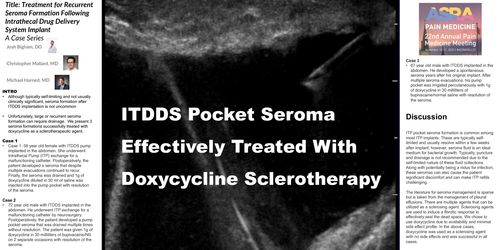
Title: Treatment for Recurrent Seroma Formation Following Intrathecal Drug Delivery System Implant 

A Case Series


INTRO

•Although typically self-limiting and not usually clinically significant, seroma formation after ITDDS implantation is not uncommon


•Unfortunately, large or recurrent seroma formation can require drainage.  We present 3 seroma formations successfully treated with doxycycline as a sclerotherapeutic agent.
•

Case 1

•Case 1: 58 year old female with ITDDS pump implanted in the abdomen. She underwent Intrathecal Pump (ITP) exchange for a malfunctioning catheter. Postoperatively, the patient developed a seroma that despite multiple evacuations continued to recur. Finally, the seroma was drained and 1g of doxycycline diluted in 30 ml of saline was injected into the pump pocket with resolution of the seroma.
•

Case 2

•72 year old male with ITDDS implanted in the abdomen. He underwent ITP exchange for a malfunctioning catheter by neurosurgery. Postoperatively, the patient developed a pump pocket seroma that was drained multiple times without resolution. The patient was given 1g of doxycycline in 30 milliliters of bupivacaine/NS on 2 separate occasions with resolution of the seroma.

Case 3

•67 year old male with ITDDS implanted in the abdomen. He developed a spontaneous seroma years after his original implant. After multiple seroma evacuations, his pump pocket was irrigated percutaneously with 1g of doxycycline in 30 milliliters of bupivacaine/normal saline with resolution of the seroma.
•

Discussion


ITP pocket seroma formation is common among most ITP implants. These are typically self-limited and usually resolve within a few weeks after implant; however, seroma fluid is an ideal medium for bacterial growth. Typically, puncture and drainage is not recommended due to the self-limited nature of these fluid collections. Along with potentially being a nidus for infection, these seromas can also cause the patient significant discomfort and can make ITP refills challenging. 

The literature for seroma management is sparse but is taken from the management of pleural effusions. There are multiple agents that can be utilized as a sclerosing agent. Sclerosing agents are used to induce a fibrotic response to effectively seal the dead space. We chose to use doxycycline due to availability and minimal side effect profile. In the above cases, doxycycline was used as a sclerosing agent with no side effects and was successful in all cases.


22nd Annual Pain Medicine Meeting 2023 » banner
Copyright © 2015-2026, ePostersLive® SciGen is a registered trademark of SciGen Technologies S.A. Patent pending.

This website and third-party tools we use rely on cookies for the best user experience. By selecting "I agree", you agree to cookie usage as described in our Privacy Policy.