425 posters, 1 videos, 9 audios, 8 topics, 53 sessions, 340 authors, 286 institutions
ePostersLive by SciGen Technologies S.A. All rights reserved.
22nd Annual Pain Medicine Meeting 2023
November 10 - 11, 2023 | New Orleans Marriott | New Orleans, Louisiana, USA

5010
CRYONEUROLYSIS OF THE SUBCOSTAL NERVE: A TECHNICAL DESCRIPTION AND A CASE REPORT
Poster Presenter
Authors
Affiliations
Part of Topic
Medically Challenging Cases
Abstract:
Cryoneurolysis has been utilized for numerous persistent and intractable painful conditions, of which the subcostal nerve, an area of chronic pain, may prove to be useful. The subcostal nerve traverses a long path before finally piercing and innervating the external oblique muscle. Because of this, it is plausible to understand the vast territory susceptible to nerve damage. Different forms of pain therapy are commonly utilized to address pain in this region, including NSAIDs, nerve blocks, and nerve ablations. Here, we present a case of a patient with 14 years of chronic rib pain who reported near-complete resolution of pain following cryoneurolysis.
Introduction:
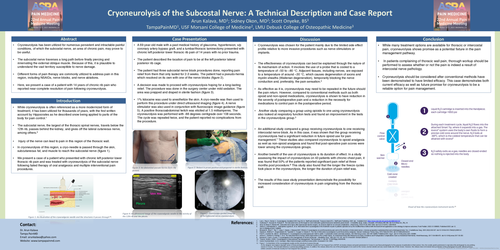
While cryoneurolysis is often referenced as a more modernized form of treatment, it has been utilized for thousands of years, with the first written account by Hippocrates as he described snow being applied to parts of the body for pain control. The subcostal nerve, the largest of the thoracic spinal nerves, travels below the 12th rib, passes behind the kidney, and gives off the lateral cutaneous nerve, among others. Injury of the nerve can lead to pain in this region of the thoracic wall. In cryoneurolysis of this region, a cryo-needle is passed through the skin, subcutaneous fat, and muscle to reach the subcostal nerve (figure 1). We present a case of a patient who presented with chronic left posterior lower thoracic rib pain and was treated with cryoneurolysis of the subcostal nerve following failed therapy of oral analgesics and multiple interventional pain procedures.
Case Presentation:
A 69-year-old male with a past medical history of glaucoma, hypertension, s/p coronary artery bypass graft, and a lumbar/thoracic laminectomy presented with chronic left posterior lower thoracic rib pain of 14 years with no prior trauma. The patient described the location of pain to be at the left posterior lateral posterior rib cage. The patient had three subcostal nerve block procedures done, reporting pain relief from them that only lasted for 2-3 weeks. The patient had a pseudo-hernia which resolved on its own with one of the nerve blocks (figure 2). A decision was made to proceed with cryoneurolysis hoping for a long-lasting relief. The procedure was done in the surgery center under mild sedation. The area was prepped and draped in sterile fashion (figure 3). 1% lidocaine was used to anesthetize the skin. A cryo-needle was then used to perform this procedure under direct ultrasound imaging (figure 4). A nerve stimulator was also used in conjunction with fluoroscopic image guidance (figure 5). A positive thoracoabdominal twitch was elicited at 1.5 milliamperes. The cryoneurolysis was performed with -88 degrees centigrade over 108 seconds. The cycle was repeated twice, and the patient reported no complications from the procedure.
Discussion:
Cryoneurolysis was chosen for the patient mainly due to the limited side effect profile relative to more invasive procedures such as nerve stimulators or implants. The effectiveness of cryoneurolysis can best be explained through the nature of its mechanism of action. It involves the use of a probe that is cooled to a temperature of −50 to −80 °C. Adjacent tissues, including nerves, are exposed to a temperature of around −30 °C, which causes degeneration of axons and myelin sheaths (Wallerian degeneration), temporarily blocking the nerve conduction and, preferably, the pain sensation. As effective as it is, cryoneurolysis may need to be repeated in the future should the pain return. However, compared to conventional methods such as both opioid and non-opioid medications, cryoneurolysis is shown to have reduction in the severity of postoperative pain and a reduction in the necessity for medications to control pain in the postoperative period. Another study comparing a group using opioids to one using cryoneurolysis also looked at respiratory function tests and found an improvement in the tests in the cryoneurolysis group. An additional study compared a group receiving cryoneurolysis to one receiving intercostal nerve block. As in this case, it was shown that the group receiving cryoneurolysis had a significant reduction in future opioid use for pain management. These studies also compared cryoneurolysis to opioid analgesia as well as non-opioid analgesia and found that post-operative pain scores were lower among the cryoneurolysis groups. Another benefit of the use of cryoneurolysis is its duration of effect. In a study assessing the impact of cryoneurolysis on 43 patients with chronic chest pain, it was found that 50% of the patients reported significant pain relief at three months post procedure. This study also found that the longer the freeze cycles took place in the cryoneurolysis, the longer the duration of pain relief was. The results of this case study presentation demonstrate the possibility for increased consideration of cryoneurolysis in pain originating from the thoracic wall.
Conclusion:
While many treatment options are available for thoracic or intercostal pain, cryoneurolysis shows promise as a potential fixture in the pain management pathway. In patients complaining of thoracic wall pain, thorough workup should be performed to assess whether or not the pain is indeed a result of intercostal nerve pathology. Cryoneurolysis should be considered after conventional methods have been demonstrated to have limited efficacy. This case demonstrates both current efficacy as well as future promise for cryoneurolysis to be a reliable option for pain management.