425 posters, 1 videos, 9 audios, 8 topics, 53 sessions, 340 authors, 286 institutions
ePostersLive by SciGen Technologies S.A. All rights reserved.
22nd Annual Pain Medicine Meeting 2023
November 10 - 11, 2023 | New Orleans Marriott | New Orleans, Louisiana, USA

4983
INTERCOSTAL RADIOFREQUENCY ABLATIONS: A PROMISING THERAPY FOR REFRACTORY INTERCOSTAL NEURALGIA
Poster Presenter
Authors
Affiliations
Part of Topic
Medically Challenging Cases
- Intercostal neuralgia is a painful condition characterized by sharp, shooting, or burning pain along the distribution of an intercostal nerve
- Most commonly presents after thoracotomies, breast surgeries, nerve entrapment, neuromas, or with herpes zoster
- Conventional therapies include NSAID’s, neuropathic, narcotics, and intercostal nerve blocks
- Case reports have demonstrated that radiofrequency ablations (RFA) can provide benefit to patients refractory to conventional treatments
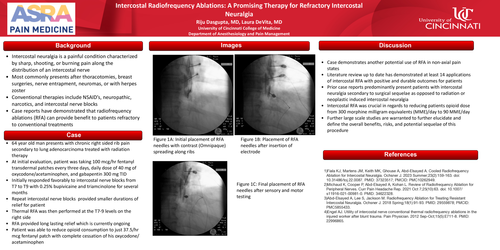
- 64 year old man presents with chronic right sided rib pain secondary to lung adenocarcinoma treated with radiation therapy
- At initial evaluation, patient was taking 100 mcg/hr fentanyl transdermal patches every three days, daily dose of 40 mg of oxycodone/acetaminophen, and gabapentin 300 mg TID
- Initially responded favorably to intercostal nerve blocks from T7 to T9 with 0.25% bupivicaine and triamcinolone for several months
- Repeat intercostal nerve blocks provided smaller durations of relief for patient
- Thermal RFA was then performed at the T7-9 levels on the right side
- RFA provided long lasting relief which is currently ongoing
- Patient was able to reduce opioid consumption to just 37.5/hr mcg fentanyl patch with complete cessation of his oxycodone/acetaminophen
- Case demonstrates another potential use of RFA in non-axial pain states
- Literature review up to date has demonstrated at least 14 applications of intercostal RFA with positive and durable outcomes for patients
- Prior case reports predominantly present patients with intercostal neuralgia secondary to surgical sequelae as opposed to radiation or neoplastic induced intercostal neuralgia
- Intercostal RFA was crucial in regards to reducing patients opioid dose from 300 morphine milligram equivalents (MME)/day to 90 MME/day
- Further large scale studies are warranted to further elucidate and define the overall benefits, risks, and potential sequelae of this procedure