425 posters, 1 videos, 9 audios, 8 topics, 53 sessions, 340 authors, 286 institutions
ePostersLive by SciGen Technologies S.A. All rights reserved.
22nd Annual Pain Medicine Meeting 2023
November 10 - 11, 2023 | New Orleans Marriott | New Orleans, Louisiana, USA

4907
CASE REPORT: PALLIATIVE CRYONEUROLYSIS FOR INTRACTABLE PAIN FROM PUDENDAL NERVE & SACRAL GANGLION PLEXUS INVASION OF PELVIC TUMOUR
Poster Presenter
Authors
Affiliations
Part of Topic
Medically Challenging Cases
CASE REPORT: PALLIATIVE CRYONEUROLYSIS FOR INTRACTABLE PAIN FROM PUDENDAL NERVE & SACRAL GANGLION PLEXUS INVASION OF PELVIC TUMOUR
Cancer-related pelvic pain is a distressing and often debilitating symptom. Given the intimate association of pelvic structures and the complexity of their innervation, pain in this region often intertwines nociceptive and neuropathic elements, posing significant challenges in terms of effective management. While cancer therapies have significantly evolved over the years, adequate pain control remains a paramount challenge for pain physicians, as the side effects of conventional analgesics and opioids can limit their utilization and compromise the quality of life for patients.
Cryoneurolysis is the application of cold temperatures to a peripheral nerve to induce a reversible nerve injury. By selectively targeting the sensory nerves responsible for transmitting pain without causing permanent damage, cryoneurolysis offers an alternative pathway to pain relief with fewer systemic side effects compared to pharmacological agents. When applied judiciously, it presents an opportunity not just for palliation but also for enhancing the patient's functional capacity, potentially allowing them to undergo necessary rehabilitative therapies.
We present a 69-year-old female with a history of Metastatic squamous cell carcinoma (SCC) of the vulva presented with intractable pelvic pain.
Brief Disease History
First diagnosed in 2012, the patient had multiple recurrences in 2016 and 2022, for which she underwent multiple surgical resections.
In 2023, she presented with severe right gluteal pain in April. Imaging (CT thoracoabdomen, MRI pelvis) revealed a 3.2cm irregular lesion on the right puborectalis. A subsequent PET scan in June detected lung metastases. An interventional radiology (IR) guided biopsy of the pelvic mass confirmed metastatic SCC. Radiotherapy were deemed unsuitable due to the size of the pelvic mass.
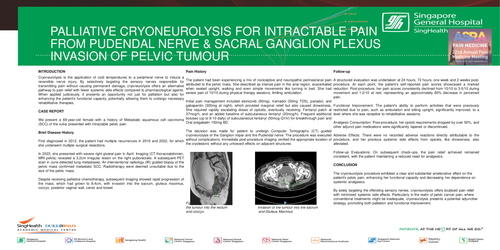
Despite receiving palliative chemotherapy, subsequent imaging showed rapid progression of the mass, which had grown to 8.4cm, with invasion into the sacrum, gluteus maximus, coccyx, posterior vaginal wall, cervix and bowel.
Pain History
The patient had been experiencing a mix of nociceptive and neuropathic perineal/anal pain attributed to the pelvic mass since April.
She described as intense pain in the anal region, exacerbated when seated upright, walking and even simple movements like turning in bed. The pain somewhat alleviates when in a reclining or leaning forward position.
Severe pain of 10/10 during physical therapy sessions, limiting ambulation. At rest or while sitting, pain remained severe at 8/10.
Initial pain management included etoricoxib (90mg), tramadol (50mg TDS), panadol, and gabapentin (300mg at night), provided marginal relief but also caused drowsiness.
Subsequent Management by Palliative Team:
In view of severity of pain and patient’s limited lifespan, the patient was referred to the hospital’s inpatient palliative team for symptom management.
She was initially started on subcutaneous fentanyl infusion (10mcg/hr) and oral pregabalin (75mg BD). Amitriptyline (10mg at night) was initiated but later discontinued due to ineffectiveness.
She required rapidly escalating doses of opioids – Prior to the procedure she was receiving:
o Fentanyl patch at 37mcg/h,
o An added baseline of subcutaneous fentanyl (20mcg/h).
o Frequent additional boluses (up to 8-10 daily) of subcutaneous fentanyl (50mcg Q1hr) for breakthrough pain.
o Oral pregabalin 150mg BD
The patient was referred for an interventional palliative procedure in view of an Excruciating, unrelenting pain exacerbated during movement and sitting, leading to increased opioid demands; Inability to undergo rehabilitation and physical therapy due to pain; Increasing sedation related to escalating fentanyl doses; Transition plan for the patient to an inpatient hospice for palliative care.
The decision was made for patient to undergo Computer Tomography (CT) guided cryoneurolysis of the Ganglion impart and the Pudendal nerve.
Protocol:
Once optimal positioning was confirmed, the cryoprobe was activated to induce localized freezing.
This freezing cycle was maintained for 10 minutes to ensure effective neurolysis, following which a thawing phase of 5 minutes was initiated. The cycle was repeated once more to ensure comprehensive nerve ablation, minimizing the likelihood of early nerve recovery and maximizing the duration of pain relief.
Check CT performed at 5 & 10 minutes of each cycle for evaluation of ablation zones.
The procedure was executed without complications. Immediate post-procedure imaging verified the appropriate location of the cryolesions without any untoward effects on adjacent structures.
Follow-up
A structured evaluation was undertaken at 24 hours, 72 hours, one week and 2 weeks post-procedure. At each point, the patient's self-reported pain scores showcased a marked reduction. Pre-procedure, she reported scores of 10/10 during exacerbating activities like ambulation and 8/10 at rest sitting up in bed. Post-procedure, these scores consistently declined to 3-5/10 during movement and 1-2/10 at rest, representing an approximately 80% decrease in perceived pain.
Functional Improvement: The patient's ability to perform activities that were previously restricted due to pain, such as ambulation and sitting upright, significantly improved. The degree of discomfort, which previously inhibited her from undergoing physiotherapy, reduced to a level where she was receptive to rehabilitative sessions.
Analgesic Consumption: The patient's reliance on systemic analgesics diminished post-procedure. Post-procedure, her opioid requirements dropped by over 50%, and other adjunct pain medications were significantly tapered or discontinued.
Adverse Effects: There were no recorded adverse reactions directly attributable to the procedure, and her previous systemic side effects from opioids, like drowsiness, also alleviated due to reduced medication.
Follow-up Evaluations: On subsequent check-ups, the pain relief achieved remained consistent, with the patient maintaining a reduced need for analgesics. The duration of sustained relief was noted, with the intention of assessing the need for any potential repeat procedures.
By solely targeting the offending sensory nerves, cryoneurolysis offers localized pain relief with minimized systemic side effects. Particularly in the realm of pelvic cancer pain, where conventional treatments might be inadequate, cryoneurolysis presents a potential adjunctive strategy, promoting both palliation and functional improvement.