425 posters, 1 videos, 9 audios, 8 topics, 53 sessions, 340 authors, 286 institutions
ePostersLive by SciGen Technologies S.A. All rights reserved.
22nd Annual Pain Medicine Meeting 2023
November 10 - 11, 2023 | New Orleans Marriott | New Orleans, Louisiana, USA

4720
IMMUNOCOMPROMISED PATIENT DEVELOPS SUBACUTE SUPERFICIAL MRSA INFECTION AFTER SPINAL CORD STIMULATOR TRIAL: A CASE REPORT
Poster Presenter
Authors
Affiliations
Part of Topic
Medically Challenging Cases
Immunocompromised Patient Develops Subacute Superficial MRSA Infection After Spinal Cord Stimulator Trial: A Case Report
Daniel Trif1, Feroz Osmani1, Magdalena Anitescu1, Tariq Malik1
1 Department of Anesthesia and Critical Care Department of Pain Medicine, University of Chicago, Chicago, IL
Abstract
•A 73 year old female with rheumatoid arthritis treated with immunosuppressive therapy underwent a spinal cord stimulator (SCS) trial with bilateral percutaneous trial leads for chronic lower back pain with neurogenic claudication. Prophylactic measures to prevent an infection were taken and in line with the standard of care. The patient had successful relief of pain and the trial leads were removed on day 5. Eleven days after trial leads removal and prior to implant, the patient endorsed a three day history of purulent discharge from the previous trial leads site. The patient was successfully treated for a superficial infection. Successful implant was completed after resolution of the infection approximately four months after removal of the trial leads.
- 1) have the patient visit multiple specialists, including Infectious Disease,
- 2) complete a one-week MRSA decolonization prior to surgery using chlorhexidine wipes,
- 3) overnight admission before surgery,
- 4) post-operative inpatient monitoring overnight,
- 5) direct implantation without trial,
- 6) the addition of intravenous Vancomycin peri-operatively,
- 7) post-operative prophylactic Bactrim,
- 8) to hold Abatacept for one month prior to implant and two months after, and
- 9) a low threshold to explant.
(1) 15 days after trial lead removal, pre-implant
(2) 7 weeks after trial lead removal, pre-implant
(3) SCS implant post-procedure day 8
(4) SCS implant post-procedure day 16
(5) SCS implant post-procedure day 22
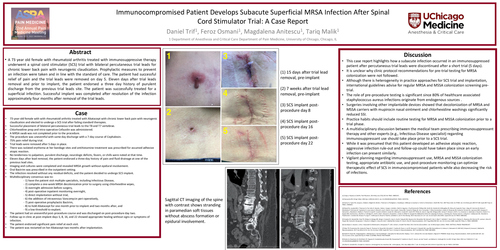
Sagittal CT imaging of the spine with contrast shows stranding in paramedian soft tissues without abscess formation or epidural involvement.
Discussion
References
[1] Song JJ, Popescu A, Bell RL. Pain Physician. 2014 May-Jun;17(3):235-46. PMID: 24850105.
[2] Darouiche RO. N Engl J Med. 2004 Apr 1;350(14):1422-9. doi: 10.1056/NEJMra035415. PMID: 15070792.
[3] Kumar K, Taylor RS, Jacques L, Eldabe S, Meglio M, Molet J, Thomson S, O'Callaghan J, Eisenberg E, Milbouw G, Buchser E, Fortini G, Richardson J, North RB. Pain. 2007 Nov;132(1-2):179-88. doi: 10.1016/j.pain.2007.07.028. Epub 2007 Sep 12. PMID: 17845835.
[4] Rauck RL, Loudermilk E, Thomson SJ, Paz-Solis JF, Bojrab L, Noles J, Vesper J, Atallah J, Roth D, Hegarty J, Prud'Homme M, Phillips GM, Smith SG, Ibrahim M, Willoughby CD, Obray JB, Gupta M, Paez J, Berg AP, Harrison NJ, Maino P, Mambalam P, McCarty M, Towlerton G, Love-Jones S, Ahmed S, Lee A, Shah B, Goor-Aryeh I, Russo MA, Varela N, Phelps JB, Cid J, Fernandez T, Pérez-Hernández C, Keehn D, Rosenow JM, Haider N, Parrent AG, Lawrence MM, Georgius P, Demartini L, Mendiola A, Mehta V, Thoma R, Israel AF, Carolis G, Bhatia S, Green M, Villarreal A, Crooks MT, Gwinn RP, Pilitsis JG, Sato H, Vega SM, Hillegass MG, Carnes P, Scherer C, Brill S, Yu J, Brennan JJ, Gatzinsky K, Navani A, Snook LT Jr, Bujedo BM, Andrés Ares J, Murillo A, Trobridge AT, Assil K, Shah J, McLeod C, Buwembo J, Coster O, Miller N, Sanapati M, Mikhael M, Przkora R, Sukenaga N, Raso LJ, Calodney AK, Cáceres Jerez LE, Uchiyama T, Kallewaard JW, Chandler B, Piedimonte F, Candido KD, Weaver TE, Agari T, Holthouse D, Woon R, Patel N, Lechleiter K, Jain R. Pain Manag. 2023 Feb;13(2):115-127. doi: 10.2217/pmt-2022-0091. Epub 2023 Jan 24. PMID: 36691862.
[5] Hoelzer BC, Bendel MA, Deer TR, Eldrige JS, Walega DR, Wang Z, Costandi S, Azer G, Qu W, Falowski SM, Neuman SA, Moeschler SM, Wassef C, Kim C, Niazi T, Saifullah T, Yee B, Kim C, Oryhan CL, Rosenow JM, Warren DT, Lerman I, Mora R, Hayek SM, Hanes M, Simopoulos T, Sharma S, Gilligan C, Grace W, Ade T, Mekhail NA, Hunter JP, Choi D, Choi DY. Neuromodulation. 2017 Aug;20(6):558-562. doi: 10.1111/ner.12609. Epub 2017 May 11. PMID: 28493599.
[6] Sarrafpour S, Hasoon J, Urits I, Viswanath O, Mahmoudi K, Simopoulos TT, Gill J, Kohan L. Anesth Pain Med. 2021 Oct 30;11(5):e120611. doi: 10.5812/aapm.120611. PMID: 35075422; PMCID: PMC8782197.
[7] Deer TR, Provenzano DA, Hanes M, Pope JE, Thomson SJ, Russo MA, McJunkin T, Saulino M, Raso LJ, Lad SP, Narouze S, Falowski SM, Levy RM, Baranidharan G, Golovac S, Demesmin D, Witt WO, Simpson B, Krames E, Mekhail N. Neuromodulation. 2017 Jan;20(1):31-50. doi: 10.1111/ner.12565. Epub 2017 Jan 2. Erratum in: Neuromodulation. 2017 Jul;20(5):516. PMID: 28042909.
[8] North R, Desai MJ, Vangeneugden J, Raftopoulos C, Van Havenbergh T, Deruytter M, Remacle JM, Shipley J, Tan Y, Johnson MJ, Van den Abeele C, Rigoard P; PROMISE Study Group. Neuromodulation. 2020 Jul;23(5):620-625. doi: 10.1111/ner.13141. Epub 2020 Apr 8. PMID: 32267989; PMCID: PMC7496399.
[9] Bode LG, Kluytmans JA, Wertheim HF, Bogaers D, Vandenbroucke-Grauls CM, Roosendaal R, Troelstra A, Box AT, Voss A, van der Tweel I, van Belkum A, Verbrugh HA, Vos MC. N Engl J Med. 2010 Jan 7;362(1):9-17. doi: 10.1056/NEJMoa0808939. PMID: 20054045.
[10] Rao N, Cannella BA, Crossett LS, Yates AJ Jr, McGough RL 3rd, Hamilton CW. J Arthroplasty. 2011 Dec;26(8):1501-7. doi: 10.1016/j.arth.2011.03.014. Epub 2011 Apr 19. PMID: 21507604.