425 posters, 1 videos, 9 audios, 8 topics, 53 sessions, 340 authors, 286 institutions
ePostersLive by SciGen Technologies S.A. All rights reserved.
22nd Annual Pain Medicine Meeting 2023
November 10 - 11, 2023 | New Orleans Marriott | New Orleans, Louisiana, USA

4704
VERTEBRAL BODY COMPRESSION FRACTURES: UNIQUE VARIETY OF MANAGEMENT IN THREE SEPARATE CASES
Poster Presenter
Authors
Affiliations
Part of Topic
Medically Challenging Cases
Introduction:
Vertebral compression fractures (VCF) occur when the vertebral body in the spine collapses, which can lead to severe and debilitating pain. VCF is the most common complication of osteoporosis, affecting more than 700,000 Americans annually (1). In severe osteoporosis, VCF can be caused by everyday activities and daily living such as stepping down a stair or lifting an object. There are also patients that do not have osteoporosis and still suffer a compression fractures. Notably, metastatic cancer, specifically breast, lung, prostate and thyroid cancers carry a higher risk to metastasize to bone and can predispose to VCF. When a VCF does occur, the management varies from conservative with range of motion and bracing to percutaneous vertebral augmentation. There is no definitive management for VCF when they do occur, and instead, treatment plans are individualized to patient specific variables such as fracture pattern, stability of fracture, mobility, and pain control. We present three different patients who all suffered a VCF in the setting of metastatic cancer, were managed with different medical and surgical approaches, and showed favorable outcomes.
Results/Case Report
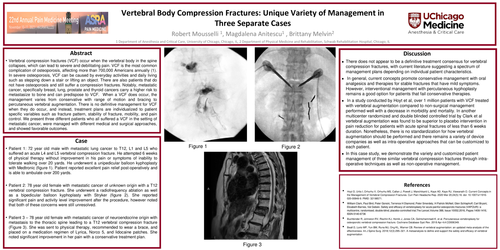
Patient 1: 72 year old male with metastatic lung cancer to T12, L1 and L5 who suffered an acute L4 and L5 vertebral compression fracture. He attempted 6 weeks of physical therapy without improvement in his pain or symptoms of inability to tolerate walking over 20 yards. He underwent a unipedicular balloon kyphoplasty with Medtronic (figure 1). Patient reported excellent pain relief post-operatively and is able to ambulate over 200 yards.
Patient 2: 78 year old female with metastatic cancer of unknown origin with a T12 vertebral compression fracture. She underwent a radiofrequency ablation as well as a bipedicular balloon kyphoplasty with Stryker (figure 2). She reported significant pain and activity level improvement after the procedure, however noted that both of these concerns were still unresolved.
Patient 3 – 78 year old female with metastatic cancer of neuroendocrine origin with metastasis to the thoracic spine leading to a T12 vertebral compression fracture (Figure 3). She was sent to physical therapy, recommended to wear a brace, and placed on a medication regimen of Lyrica, Norco 5, and lidocaine patches. She noted significant improvement in her pain with a conservative treatment plan.
Discussion:
There does not appear to be a definitive treatment consensus for vertebral compression fractures, with current literature suggesting a spectrum of management plans depending on individual patient characteristics. In general, current concepts promote conservative management with oral analgesics and therapies for stable fractures that have mild symptoms. However, interventional management with percutaneous kyphoplasty remains a good option for patients that fail conservative therapies. In a study conducted by Hoyt et al, over 1 million patients with VCF treated with vertebral augmentation compared to non-surgical management performed well with a decrease in morbidity and mortality. In another multicenter randomized and double blinded controlled trial by Clark et al vertebral augmentation was found to be superior to placebo intervention in pain reduction for patients with acute spinal fractures of less than 6 weeks duration. Nonetheless, there is no standardization for how vertebral augmentation should be performed and there remains a variety of device companies as well as intra-operative approaches that can be customized to each patient. In this case study, we demonstrate the variety and customized patient management of three similar vertebral compression fractures through intra-operative techniques as well as non-operative management.