425 posters, 1 videos, 9 audios, 8 topics, 53 sessions, 340 authors, 286 institutions
ePostersLive by SciGen Technologies S.A. All rights reserved.
22nd Annual Pain Medicine Meeting 2023
November 10 - 11, 2023 | New Orleans Marriott | New Orleans, Louisiana, USA

4871
THE USE OF STELLATE GANGLION BLOCK FOR POST- COVID-19 PLEURITIC CHEST PAIN
Poster Presenter
Authors
Affiliations
Part of Topic
Medically Challenging Cases
The COVID-19 pandemic has had an unprecedented global impact, leading to millions of cases worldwide. While much attention has been devoted to the acute phase of the illness, it is increasingly evident that post-recovery complications can significantly affect survivors' quality of life. One such complication is pleuritic chest pain. Despite the advances in COVID-19 management, the optimal approach to managing post-recovery pleuritic chest pain remains elusive, necessitating further exploration of innovative treatment modalities. However, the potential utility of SGBs in managing post-COVID pleuritic chest pain has not been extensively explored. Pleuritic chest pain in post-COVID patients can be debilitating, impairing respiratory function, hindering daily activities, and reducing overall well-being. Therefore, investigating the effectiveness of SGBs in alleviating this distressing symptom could hold significant clinical implications for improving the post-recovery care of COVID-19 survivors.
The stellate ganglion, a collection of sympathetic ganglia located at the level of the seventh cervical vertebra, plays a crucial role in regulating various physiological processes, including vascular tone and pain transmission. The use of stellate ganglion blocks (SGBs) as an interventional pain management technique has gained traction in recent years, particularly in conditions associated with sympathetic overactivity and neuropathic pain. Through the blockade of sympathetic nerve fibers, SGBs have been proven effective in providing relief for conditions such as complex regional pain syndrome, post-traumatic stress disorder, and refractory angina.
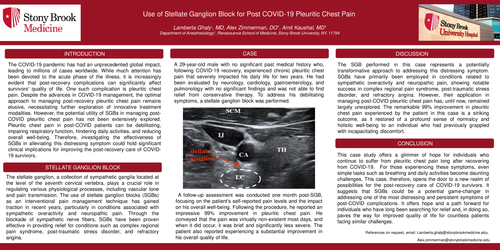
A 29-year-old male with no significant past medical history who, following COVID-19 recovery, experienced chronic pleuritic chest pain that severely impacted his daily life for two years. He had been evaluated by neurology, cardiology, gastroenterology, and pulmonology with no significant findings and was not able to find relief from conservative therapy. To address his debilitating symptoms, a stellate ganglion block was performed.
A follow-up assessment was conducted one month post-SGB, focusing on the patient's self-reported pain levels and the impact on his overall well-being. Following the procedure, he reported an impressive 99% improvement in pleuritic chest pain. He conveyed that the pain was virtually non-existent most days, and when it did occur, it was brief and significantly less severe. The patient also reported experiencing a substantial improvement in his overall quality of life.
The SGB performed in this case represents a potentially transformative approach to addressing this distressing symptom. SGBs have primarily been employed in conditions related to sympathetic overactivity and neuropathic pain, showing notable success in complex regional pain syndrome, post-traumatic stress disorder, and refractory angina. However, their application in managing post-COVID pleuritic chest pain has, until now, remained largely unexplored. The remarkable 99% improvement in pleuritic chest pain experienced by the patient in this case is a striking outcome, as it restored of a profound sense of normalcy and holistic well-being to an individual who had previously grappled with incapacitating discomfort.
This case study offers a glimmer of hope for individuals who continue to suffer from pleuritic chest pain long after recovering from COVID-19. For those experiencing these symptoms, even simple tasks such as breathing and daily activities become daunting challenges. This case, therefore, opens the door to a new realm of possibilities for the post-recovery care of COVID-19 survivors. It suggests that SGBs could be a potential game-changer in addressing one of the most distressing and persistent symptoms of post-COVID complications. It offers hope and a path forward for individuals who have long been searching for relief and, in doing so, paves the way for improved quality of life for countless patients facing similar challenges.