425 posters, 1 videos, 9 audios, 8 topics, 53 sessions, 340 authors, 286 institutions
ePostersLive by SciGen Technologies S.A. All rights reserved.
22nd Annual Pain Medicine Meeting 2023
November 10 - 11, 2023 | New Orleans Marriott | New Orleans, Louisiana, USA

4866
SYMPTOM MANAGEMENT OF L3 RADICULOPATHY IN A PATIENT WITH A LUMBAR SCHWANNOMA USING A CAUDAL CATHETER EPIDURAL STEROID INJECTION
Poster Presenter
Authors
Affiliations
Part of Topic
Medically Challenging Cases
Introduction:
•Lumbar radiculopathy is characterized by radiating pain, sensory disturbances, and motor deficits along the distribution of a lumbar nerve root and has an estimated prevalence between 3%-5% of the population.1 Radiculopathy, primarily stems from the irritation of specific nerves, often inducted by compression occurring at various locations along the nerve’s trajectory.
•Although less common, spinal cord tumors can be the cause of a progressive radiculopathy.
•Here we present a case of an extradural lumbar schwannoma causing treatment resistant radiculopathy that was successfully treated with caudal catheter epidural steroid injections
Case Presentation:
•A 69-year-old female presented with a 2-year history of recurrent low back pain with left-sided L3 radiculopathy accompanied by lower extremity weakness resistant to conservative treatment.
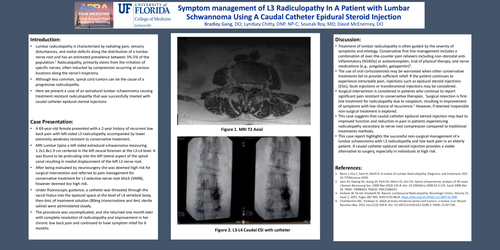
•MRI Lumbar Spine a left-sided extradural schwannoma measuring 1.2x1.8x1.9 cm centered in the left neural foramen at the L3-L4 level. It was found to be protruding into the left lateral aspect of the spinal canal resulting in medial displacement of the left L3 nerve root.
•After being evaluated by neurosurgery she was deemed high risk for surgical intervention and referred to pain management for conservative treatment for L3 selective nerve root block (SNRB), however deemed too high risk.
•Under fluoroscopic guidance, a catheter was threaded through the sacral hiatus into the epidural space at the level of L4 vertebral body, then 6mL of treatment solution (80mg triamcinolone and 4mL sterile saline) were administered slowly.
•The procedure was uncomplicated, and she returned one month later with complete resolution of radiculopathy and improvement in her chronic low back pain and continued to have symptom relief for 6 months.
Discussion:
•Treatment of lumbar radiculopathy is often guided by the severity of symptoms and etiology. Conservative first line management includes a combination of over-the-counter pain relievers including non-steroidal anti-inflammatory (NSAIDs) or acetaminophen, trial of physical therapy, and nerve medications (e.g., pregabalin, gabapentin)3.
•The use of oral corticosteroids may be warranted when other conservative treatments fail to provide sufficient relief. If the patient continues to experience intractable pain, injections such as epidural steroid injections (ESIs), facet injections or transforaminal injections may be considered.
•Surgical intervention is considered in patients who continue to report significant pain resistant to conservative therapies. Surgical resection is first-line treatment for radiculopathy due to neoplasm, resulting in improvement of symptoms with low chance of recurrence.1 However, if deemed inoperable non-surgical treatment is explored.
•This case suggests that caudal catheter epidural steroid injection may lead to improved function and reduction in pain in patients experiencing radiculopathy secondary to nerve root compression compared to traditional treatments methods.
•This case report highlights the successful non-surgical management of a lumbar schwannoma with L3 radiculopathy and low back pain in an elderly patient. A caudal catheter epidural steroid injection provides a viable alternative to surgery, especially in individuals at high risk.