425 posters, 1 videos, 9 audios, 8 topics, 53 sessions, 340 authors, 286 institutions
ePostersLive by SciGen Technologies S.A. All rights reserved.
22nd Annual Pain Medicine Meeting 2023
November 10 - 11, 2023 | New Orleans Marriott | New Orleans, Louisiana, USA

4816
FEMOROACETABULAR IMPINGEMENT: A REAL PAIN IN THE BACK
Poster Presenter
Authors
Affiliations
Part of Topic
Medically Challenging Cases
Femoroacetabular Impingement (FAI)
A Real Pain in the Back
Tiffany Chan MD, Joel Abraham MD, Michael Medina MD
INTRO
FAI is thought to arise from bone deformity
Pain 2/2 friction b/t femoral head and acetabulum eroding into cartilaginous labrum
Risk factor for OA
Gait disturbance & hip/groin pain are common
Can rarely present with isolated LBP
METHODS
Informed consent was obtained from patient for case report. IRB approval not required
PATIENT PRESENTATION
29 yo M with 12+ years of back pain
Lower lumbar region, band-like distribution between the iliac crests and sacroiliac joints
Worse with activity, left side worse than right
No hip pain, radiculopathy, or weakness.
No inciting event.
PHYSICAL EXAM
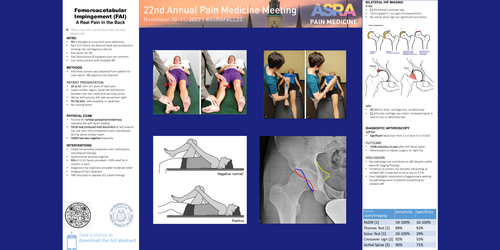
Positive for lumbar paraspinal tenderness, reproducible with facet loading
FADIR test produced mild discomfort at left anterior hip, but very mild compared to pain reproduced during above lumbar exam.
FABER test was negative bilaterally.
INTERVENTIONS
Failed conservative treatment with medications and physical therapy
Autoimmune workup negative.
RFA of L3-S1 facets provided > 50% relief for 6 months in past.
Diagnostic hip injections provided moderate relief
Imaging of hips obtained
ORS reluctant to operate d/t subtle findings
BILATERAL HIP IMAGING
X-ray:
(L) Peripheral crossover sign
Tönnis grade 0 = no signs of osteoarthritis
No ischial spine sign nor significant cam lesion
MRI:
(R) Mild to mod. cartilage loss; no labral tear
(L) Articular cartilage was intact; increased signal in labrum but no definitive tear
DIAGNOSTIC ARTHROSCOPY
Left hip:
Significant labral tear from 11 o'clock to 3 o'clock
OUTCOME
>90% reduction in pain after left labral repair.
Patient plans to repeat surgery on right hip.
DISCUSSION
Hip pathology can contribute to LBP, despite subtle exam & imaging findings.
Incidence of primary hip disorder presenting as isolated LBP is reported to be as low as 2.5%.
Case highlights importance of aggressively seeking hip pathology even in patients presenting w/ isolated LBP.