425 posters, 1 videos, 9 audios, 8 topics, 53 sessions, 340 authors, 286 institutions
ePostersLive by SciGen Technologies S.A. All rights reserved.
22nd Annual Pain Medicine Meeting 2023
November 10 - 11, 2023 | New Orleans Marriott | New Orleans, Louisiana, USA

4764
A MULTIDISCIPLINARY APPROACH TO PAIN AND FUNCTION: A CASE OF OSTEOMALACIA SECONDARY TO A CERVICAL FGF23 MESENCHYMAL TUMOR
Poster Presenter
Authors
Affiliations
Part of Topic
Medically Challenging Cases
Title:
A Multidisciplinary Approach to Pain and Function: A Case of Osteomalacia Secondary to a Cervical FGF23 Mesenchymal Tumor
Introduction:
Tumor induced osteomalacia (TIO) is a rare paraneoplastic syndrome characterized by hypophosphatemia, reduced 1,25-dihydroxyvitamin D3 synthesis and osteomalacia secondary to FGF23 overexpression (1). In most reviewed cases, surgical removal of the associated tumor led to resolution of symptoms. However, time from symptom onset to tumor identification was often lengthy and patients suffered for years before a diagnosis was made. Here, we present a case of TIO secondary to a fibroblast growth factor 23 (FGF23) positive mesenchymal tumor in the C2 vertebrae. Prior to identification of the tumor, this patient experienced recurrent stress fractures in bilateral lower extremities, diffuse bone pain and functional decline. Due to risk of cervical instability, prompt radiation therapy in the form of stereotactic body radiation therapy (SBRT) followed by kyphoplasty was required. Through a multidisciplinary multispecialty approach, pain was reduced and physical function was improved.
Case Report:
A 66 year-old male with a significant history of chronic pain secondary to osteoarthritis, severe diffuse degenerative disc disease and osteoporosis with recurrent stress fractures in the bilateral lower extremities presented to the pain clinic. Pain and functional status had worsened and he was forced to utilize a walker for ambulation and to retire on disability. A cervical spine x-ray three years prior to presentation demonstrated stepwise retrolisthesis of C3 on C4 with no significant change on flexion/extension and multilevel degenerative changes. A dexa scan one year later revealed a T score of -1.6 in the right femoral neck and -2.8 of the left hip trochanter.
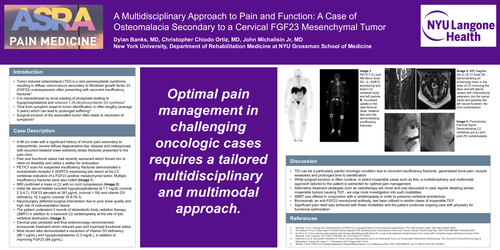
The endocrinology team ordered a PET/CT scan as part of the workup for suspected insufficiency fractures, which demonstrated a somatostatin receptor 2 (SSTR2) expressing lytic lesion at his C2 vertebrae indicative of a FGF23 positive mesenchymal tumor (Image 1). Cortex destruction and infiltration of the epidural and neuroforaminal space were noted (Image 2). Multiple insufficiency fractures were also noted, including in the bilateral lower extremities, ribs and femoral neck (Image 1) and an incidental 1.2cm SSRT2-expressing pancreatic tail nodule was found. Initial lab abnormalities included hypophosphatemia at 1.7 (normal 2.3-4.7), significant FGF23 elevation at 281 (normal < 59), depressed vitamin D3 19.3 (normal 19.9-79.3) and elevated alkaline phosphatase at 78.5 (normal 6.5-20.1).
The patient was seen by neurosurgery who recommended radiation therapy and kyphoplasty due to poor bone quality and high risk of instrumentation failure with surgical intervention. The patient subsequently established care with radiation oncology and underwent three rounds of SBRT. Repeat labs one month after completion SBRT demonstrated a reduction of FGF23 to 88, an increase in phosphorus to 2.7 and an increase in vitamin D3 to 96.1. Subsequently, the patient required a transoral C2 vertebroplasty at the site of the lytic vertebral destruction (Image 3). Despite an uncomplicated procedure, the patient continued to complain of intermittent 9/10 cervical pain, diffuse bony pain, generalized fatigue and discomfort in the dorsal feet bilaterally. Under the care of endocrinology, the patient completed two courses of burosumab infusions with significant reduction in pain to 1/10. The patient is now ambulating with a cane rather than a walker. Despite improvement in functional status and reduction in pain, neck stiffness has persisted. Most recent labs after burosumab demonstrated a resolution of hypophosphatemia now at 3.3. A repeat FGF23 value has not been obtained since completion of the burosumab regimen.
Follow up CT 3 years after initial tumor discovery demonstrated a stable C2 lytic lesion without evidence of progression. GI recommended routine monitoring of the pancreatic tail nodule, which has been stable. Fine needle biopsy identified benign pancreatic cells.
Discussion:
In the case described, numerous insufficiency fractures led to the diagnosis of a FGF23 secreting mesenchymal tumor. TIO is a unique paraneoplastic syndrome associated with FGF23 secreting tumors. It is characterized by renal wasting of phosphate causing aggressive demineralization of bones. Hypophosphatemia with elevated FGF23 are attributable lab abnormalities (2). Tumors associated with TIO are frequently small and slow-growing. This causes delay in identification, with an average of 5 years from time of osteomalacia onset to tumor localization (3). In this case, the time from symptom onset to tumor localization was approximately 4 years.
Patients with TIO are classically resistant to vitamin D supplementation (3) and while in most cases surgical excision of the tumor is curative, surgery was not recommended for this patient as it would have been unlikely to improve symptomatology and may have led to worsening of spinal alignment. Due to poor bone quality and extensive insufficiency fractures, surgery likely would have required stabilization potentially up to the occiput. Instead, SBRT was offered in conjunction with a vertebroplasty in order to preserve vertebral architecture and address the patient's pain. Alternative treatment modalities such as radiotherapy, as utilized in this case, are novel and mainly discussed in case reports detailing inoperable tumors causing TIO (4). The initial SBRT course was effective in stabilizing the tumor as indicated by the significant reduction in FGF23 and improvement in phosphorus level. Pain persisted for this patient, specifically in his neck and diffusely in his bones. Four months after SBRT completion, endocrinology initiated burosumab, an anti-FGF23 monoclonal antibody which has been utilized in other similar cases of inoperable TIO (5). Eventually, after 2 infusions of burosumab, the patient reported significant reduction in pain from 9/10 to 1/10. The patient was referred to physiatry for improvement in functional status and ongoing neck stiffness.
This is an extraordinarily unique and interesting case from multiple perspectives. The authors would like to highlight that effectively addressing challenging pain cases and tailoring treatment to our patients requires a team effort that often relies upon close collaboration with numerous specialty teams working cohesively.