425 posters, 1 videos, 9 audios, 8 topics, 53 sessions, 340 authors, 286 institutions
ePostersLive by SciGen Technologies S.A. All rights reserved.
22nd Annual Pain Medicine Meeting 2023
November 10 - 11, 2023 | New Orleans Marriott | New Orleans, Louisiana, USA

4681
NAVIGATING AID INTERFERENCE: A COMPLEX CASE DURING CERVICAL RADIOFREQUENCY ABLATION
Poster Presenter
Authors
Affiliations
Part of Topic
Medically Challenging Cases
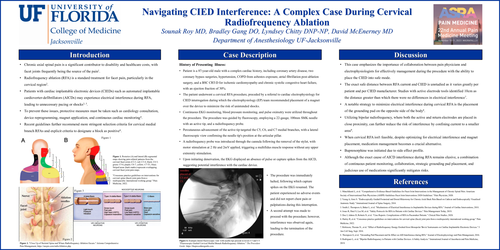
Navigating CIED Interference: A Complex Case During Cervical Radiofrequency Ablation.
Sounak Roy MD, Bradley Gang DO, Lyndsey Chitty DNP-NP, David McEnerney MD Department of Anesthesiology UF-Jacksonville
Introduction:
Chronic axial spinal pain is a significant contributor to disability and healthcare costs, with facet joints frequently being the source of the pain.
Radiofrequency ablation (RFA) is a standard treatment for facct pain, particularly in the cervical region.
Patients with cardiac implantable electronic devices (CIEDs) such as automated implantable cardioverter-defibrillators (AICDs) may experience electrical interference during RFA, leading to unnecessary pacing or shocks.
To prevent these issues, protective measures must be taken such as cardiology consultation, device reprogramming, magnet application, and continuous cardiac monitoring.
Recent guidelines further recommend more stringent selection criteria for cervical medial branch RFAs and explicit criteria to designate a block as positive.
Case Description:
History of Presenting Illness:
• Patient is a 87-year-old male with a complex cardiac history, including coronary artery disease, two coronary bypass surgeries, hypertension, COPD from asbestos exposure, atrial fibrillation post-ablation surgery, and a BSC CRT-D for ischemic cardiomyopathy and chronic systolic congestive heart failure, with an ejection fraction of 30%.
• The patient underwent a cervical RFA procedure, preceded by a referral to cardiac electrophysiology for CIED interrogation during which the electrophysiology (EP) team recommended placement of a magnet over the device to minimize the risk of unintended shocks.
• Continuous EKG monitoring, blood pressure monitoring, and pulse oximetry were utilized throughout the procedure. The procedure was guided by fluoroscopy, employing a 22-gauge, 100mm SMK needle with an active tip, and a radiofrequency probe.
• Percutaneous advancement of the active tip targeted the C5, C6, and C7 medial branches, with a lateral fluoroscopic view confirming the needle tip's position at the articular pillar.
• A radiofrequency probe was introduced through the cannula following the removal of the stylet, with motor stimulation at 2 Hz and 2mV applied, triggering a multifidus muscle response without any upper extremity stimulation.
• Upon initiating denervation, the EKG displayed an absence of pulse or capture spikes from the AICD, suggesting potential interference with the cardiac device.
• The procedure was immediately halted, following which capture spikes on the EKG resumed. The patient experienced no adverse events and did not report chest pain or palpitations during this interruption.
• A second attempt was made to proceed with the procedure; however, interference was observed again, leading to the termination of the procedure.
Discussion:
This case emphasizes the importance of collaboration between pain physicians and electrophysiologists for effectively management during the procedure with the ability to place the CIED into safe mode.
The exact safe distance between RFA current and CIED is unstudied as it varies greatly per patient and per CIED manufacturer. Studies with active electrode tools identified 10cm as the distance greater than which there were no differences in electrical interference?. A notable strategy to minimize electrical interference during cervical RFA is the placement of the grounding pad on the opposite side of the bodys.
Utilizing bipolar radiofrequency, where both the active and return electrodes are placed in close proximity, can further reduce the risk of interference by confining current to a smaller area'.
When cervical RFA isn't feasible, despite optimizing for electrical interference and magnet placement, medication management becomes a crucial alternative.
Buprenorphine was initiated due to side effect profile.
Although the exact cause of AICD interference during RFA remains elusive, a combination of continuous patient monitoring, collaboration, strategic grounding pad placement, and judicious use of medications significantly mitigates risks.
References:
1. Manchikanti L, et al. "Comprehensive Evidence-Based Guidelines for Facet Joint Interventions in the Management of Chronic Spinal Pain: American Society of Interventional Pain Physicians (ASIPP) Guidelines Facet Joint Interventions 2020 Guidelines." Pain Physician, 2020.
2. Yeung A, Gore S. "Endoscopically Guided Foraminal and Dorsal Rhizotomy for Chronic Axial Back Pain Based on Cadaver and Endoscopically Visualized Anatomic Study." International Journal of Spine Surgery, 2014.
3. Smith J, Thompson A, Baker L, et al. "Mechanisms of Electrical Interference in Implantable Devices during RFA." Journal of Cardiac Interventions, 2018. 4. Jones R, Patel S, Lee M, et al. "Safety Protocols for RFA in Patients with Cardiac Devices." Pain Management Today, 2019.
5. Doe J, Adams D, Roberts N, et al. "Case Reports: Complications of RFA in Pacemaker Patients." Clinical Pain Studies, 2020.
6. Hurley R, et al. "Consensus practice guidelines on interventions for cervical spine (facet) joint pain from a multispecialty international working group." Pain Medicine, 2022.
7. Robinson, Thomas N., et al. "Effect of Radiofrequency Energy Emitted from Monopolar 'Bovie' Instruments on Cardiac Implantable Electronic Devices." J Am Coll Surg, Sept. 2014.
8. Thompson G, et al. "Grounding Pad Placement and Its Effect on AID Interference during RFA." Journal of Electrophysiology and Pain Management, 2016.
9. Rodriguez L, et al. "Bipolar Radiofrequency in Patients with Cardiac Devices: A Safety Analysis." International Journal of Anesthesia and Pain Medicine, 2019.