425 posters, 1 videos, 9 audios, 8 topics, 53 sessions, 340 authors, 286 institutions
ePostersLive by SciGen Technologies S.A. All rights reserved.
22nd Annual Pain Medicine Meeting 2023
November 10 - 11, 2023 | New Orleans Marriott | New Orleans, Louisiana, USA

4608
RADIOFREQUENCY ABLATION OF THE THORACIC DESCENDING BRANCH OF THE POSTERIOR RAMI - AN EFFECTIVE INTERVENTION FOR FACET JOINT PAIN
Poster Presenter
Authors
Affiliations
Part of Topic
Medically Challenging Cases
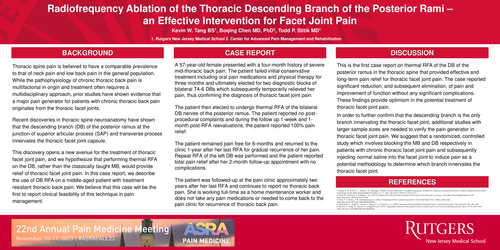
Radiofrequency Ablation of the Thoracic Descending Branch of the Posterior Rami – an Effective Intervention for Facet Joint Pain
Kevin W. Tang BS1, Boqing Chen MD, PhD2, Todd P. Stitik MD1
1. Rutgers New Jersey Medical School 2. Center for Advanced Pain Management and Rehabilitation
BACKGROUND
Thoracic spine pain is believed to have a comparable prevalence to that of neck pain and low back pain in the general population. While the pathophysiology of chronic thoracic back pain is multifactorial in origin and treatment often requires a multidisciplinary approach, prior studies have shown evidence that a major pain generator for patients with chronic thoracic back pain originates from the thoracic facet joints.
Recent discoveries in thoracic spine neuroanatomy have shown that the descending branch (DB) of the posterior ramus at the junction of superior articular process (SAP) and transverse process innervates the thoracic facet joint capsule.
This discovery opens a new avenue for the treatment of thoracic facet joint pain, and we hypothesize that performing thermal RFA on the DB, rather than the classically taught MB, would provide relief of thoracic facet joint pain. In this case report, we describe the use of DB RFA on a middle-aged patient with treatment resistant thoracic back pain. We believe that this case will be the first to report clinical feasibility of this technique in pain management.
CASE REPORT
A 57-year-old female presented with a four-month history of severe mid-thoracic back pain. The patient failed initial conservative treatment including oral pain medications and physical therapy for three months and ultimately elected for two diagnostic blocks of bilateral T4-6 DBs which subsequently temporarily relieved her pain, thus confirming the diagnosis of thoracic facet joint pain.
The patient then elected to undergo thermal RFA of the bilateral DB nerves of the posterior ramus. The patient reported no post-procedural complaints and during the follow up 1-week and 1-month post-RFA reevaluations, the patient reported 100% pain relief.
The patient remained pain free for 6-months and returned to the clinic 1-year after her last RFA for gradual recurrence of her pain. Repeat RFA of the left DB was performed and the patient reported total pain relief after her 2-month follow-up appointment with no complications.
The patient was followed-up at the pain clinic approximately two years after her last RFA and continues to report no thoracic back pain. She is working full-time as a home maintenance worker and does not take any pain medications or needed to come back to the pain clinic for recurrence of thoracic back pain.
DISCUSSION
This is the first case report on thermal RFA of the DB of the posterior ramus in the thoracic spine that provided effective and long-term pain relief for thoracic facet joint pain. The case reported significant reduction, and subsequent elimination, of pain and improvement of function without any significant complications. These findings provide optimism in the potential treatment of thoracic facet joint pain.
In order to further confirm that the descending branch is the only branch innervating the thoracic facet joint, additional studies with larger sample sizes are needed to verify the pain generator in thoracic facet joint pain. We suggest that a randomized, controlled study which involves blocking the MB and DB respectively in patients with chronic thoracic facet joint pain and subsequently injecting normal saline into the facet joint to induce pain as a potential methodology to determine which branch innervates the thoracic facet joint.
REFERENCES
1. Briggs, A. M., Smith, A. J., Straker, L. M., &Bragge, P. (2009). Thoracic spine pain in the general population: Prevalence, incidence and associated factors in children, adolescents and adults. A systematic review. BMC Musculoskeletal Disorders, 10, 77. https://doi.org/10.1186/1471-2474-10-77
2. Froud, R., Patterson, S., Eldridge, S. et al. (2014) A systematic review and meta-synthesis of the impact of low back pain on people’s lives. BMC Musculoskelet Disord 15, 50 https://doi.org/10.1186/1471-2474-15-50
3. Yong, R. J., Mullins, P. M., & Bhattacharyya, N. (2022). Prevalence of chronic pain among adults in the United States. Pain, 163(2), e328–e332. https://doi.org/10.1097/j.pain.0000000000002291
4. Manchikanti, L., Singh, V., Pampati, V., Beyer, C. D., & Damron, K. S. (2002). Evaluation of the prevalence of facet joint pain in chronic thoracic pain. Pain physician, 5(4), 354–359.
5. Ishizuka, K., Sakai, H., Tsuzuki, N., & Nagashima, M. (2012). Topographic anatomy of the posterior ramus of thoracic spinal nerve and surrounding structures. Spine, 37(14), E817-822. https://doi.org/10.1097/BRS.0b013e31824b65ea