425 posters, 1 videos, 9 audios, 8 topics, 53 sessions, 340 authors, 286 institutions
ePostersLive by SciGen Technologies S.A. All rights reserved.
22nd Annual Pain Medicine Meeting 2023
November 10 - 11, 2023 | New Orleans Marriott | New Orleans, Louisiana, USA

4590
SUCCESS OF NEUROMODULATION IN A PATIENT WITH FAILED BACK SURGERY SYNDROME (FBSS) AND ARACHNOIDITIS – A CASE REPORT
Poster Presenter
Authors
Affiliations
Part of Topic
Medically Challenging Cases
TITLE: Success of Neuromodulation in a Patient with Failed Back Surgery Syndrome (FBSS) and Arachnoiditis – A Case Report
AUTHORS & AFFILIATIONS: Trishul Kapoor MD1, Jijun Xu MD PhD1
- Department of Pain Management, Cleveland Clinic, Cleveland, OH
INTRODUCTION
It is estimated that nearly 51-84% of adults experience chronic low back pain during the course of their lifetime.1 This has drastically increased the number of surgical interventions of the spine being performed.1 This in turn has increased the incidence of failed back surgery syndrome (FBSS).1 In the setting of FBSS, there have been numerous case reports of arachnoiditis; a persistent inflammation of the arachnoid mater that results in membrane thickening, dural adhesions, scar tissue formation, clumping of nerve roots, ossification, spinal cord swelling, and syringomyelia.2 Arachnoiditis is an incurable disease with debilitating pain that is challenging to treat.2 Conventional therapies including medications (NSAIDs, opioids, anticonvulsants, antidepressants, etc.), physical therapy, and psychotherapy often fail to adequately address patients’ pain.2 Neuromodulation is an FDA-approved therapy for arachnoiditis, but literature describing the role of neuromodulation in patients with arachnoiditis is scarce.3 In this medically challenging case report, we describe a 57-year-old female with a complex past medical and surgical history significant for chronic back pain in the setting of FBSS and arachnoiditis who underwent successful neuromodulation therapy with a spinal cord stimulator (SCS) trial and permanent implantation.
METHODS
A retrospective chart review of one patient was conducted in 2023. This study was determined to be exempt from Institutional Review Board at the Cleveland Clinic. The participant described in this study provided informed consent to be included in this case report.
RESULTS
This is a 57-year-old female with a pertinent history of lumbar adhesive arachnoiditis presented to the Cleveland Clinic Pain Management Department with chronic lower mid-thoracic and lumbar back pain. She has a medical history significant for Nonalcoholic Steatohepatitis (NASH)-induced liver cirrhosis, chronic thrombocytopenia, essential hypertension (HTN), type 2 diabetes mellitus (T2DM), rheumatoid arthritis (RA), obstructive sleep apnea (OSA), nephrolithiasis, bipolar disorder type 1, Cushing’s syndrome, and pulmonary hypertension (PHTN). She has a surgical history significant for anterior cervical discectomy and fusion at C5-C6 (2001), vaginal hysterectomy (2003), lumbar laminectomy (L4-S1 in 2003, posterior spine fusion of L3-L4 in 2007), laparoscopic cholecystectomy (2007), transjugular intrahepatic portosystemic shunt procedure (2017), total abdominal colectomy with ileostomy creation and subsequent parastomal hernia revisions (2014), and parathyroidectomy (2019). In 2022, the patient was referred to the PMC for evaluation of placement of a SCS implant.
Upon initial evaluation in clinic, she described a constant sharp burning pain in the lower mid-thoracic and lumbar spine region with radiation to the posterolateral leg and dorsolateral foot. The pain was exacerbated by any physical activity. She was unable to identify any alleviating factors. On physical examination, the patient exhibited tenderness to palpation over the lumbar spinous processes, paraspinal muscles, and right sacroiliac joint (SIJ). Provocative testing revealed a positive straight leg raising test and Gaenslen test on the right. She demonstrated symmetric right and left, upper and lower extremity sensation and strength. The patient did not have any opioid prescriptions at the time of evaluation, but had undergone numerous procedures, described below, over the course of 4 years.
2018 – Uncomplicated caudal epidural steroid injection (80mg of Triamcinolone and 5 ml of 0.5% Lidocaine). She had 70% relief for 2 months.
2019 – Uncomplicated L5-S1 interlaminar epidural steroid injection (80mg of Triamcinolone, 1ml of 0.5% Lidocaine, 5ml of normal saline). She had 50% relief for 3 months.
2020 – Uncomplicated L5-S1 interlaminar epidural steroid injection (80mg of Triamcinolone, 1ml of 0.5% Lidocaine, 5ml of normal saline). She had 60% relief for 5 months.
2021 – Uncomplicated caudal epidural steroid injection (unspecified medication doses). She had no analgesic relief with this procedure.
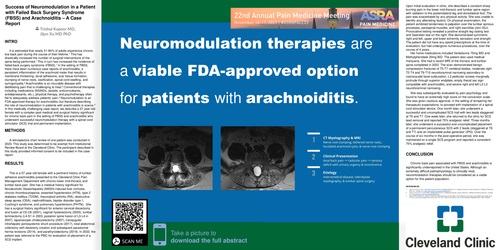
Her home medications included Venlafaxine 75mg BID and Methylphenidate 20mg BID. The patient also used medical marijuana. She had a recent MRI of the thoracic and lumbar spine completed in 2022. The scan demonstrated benign compression fractures of T5-T7 vertebral bodies, moderate right T2-T4 and T9-T10 neuroforaminal narrowing secondary to rostrocaudal facet subluxation, L3 pedicular screws marginally protrude through superior endplate, empty thecal sac sign compatible with arachnoiditis, and severe right and left L2-L3 neuroforaminal narrowing.
She was subsequently evaluated by pain psychology and found to have an extremely high score on the conversion scale. She was given cautious approval, in the setting of tempering her therapeutic expectations, to proceed with implantation of a spinal cord stimulator device. One month later, she underwent a successful and uncomplicated SCS trail with two leads staggered at T6 and T7. One week later, she returned to the clinic for SCS lead removal and reported 75% analgesic relief. Three months later, she underwent a successful and uncomplicated placement of a permanent percutaneous SCS with 2 leads (staggered at T6 and T7) and an implantable pulse generator (IPG). Over the course of six months in the post-operative period, she was maintained on a single SCS program and reported a consistent 75% analgesic relief.
CONCLUSION
Chronic back pain associated with FBSS and arachnoiditis is significantly underreported in the United States. Although an extremely difficult pathophysiology to clinically treat, neuromodulation therapies should be considered as a viable option for this patient population.
REFERENCES:
- Orhurhu VJ, Chu R, Gill J. Failed Back Surgery Syndrome. [Updated 2023 May 1]. In: StatPearls [Internet]. Treasure Island (FL): StatPearls Publishing; 2023 Jan-. Available from: https://www.ncbi.nlm.nih.gov/books/NBK539777/
- Peng H, Conermann T. Arachnoiditis. [Updated 2022 Oct 31]. In: StatPearls [Internet]. Treasure Island (FL): StatPearls Publishing; 2023 Jan-. Available from: https://www.ncbi.nlm.nih.gov/books/NBK555973/
- Meilman PW, Leibrock LG, Leong FT. Outcome of implanted spinal cord stimulation in the treatment of chronic pain: arachnoiditis versus single nerve root injury and mononeuropathy. Brief clinical note. Clin J Pain. 1989 Jun;5(2):189-93. doi: 10.1097/00002508-198906000-00010. PMID: 2520402.