66 posters, 2 videos, 1 audios, 2 topics, 162 authors, 49 institutions
ePostersLive by SciGen Technologies S.A. All rights reserved.
American College of Prosthodontists - 2020 ANNUAL SESSION
November 4-7 | Virtual Meeting
97
Flexural Strength and Modulus of 3D-Printed and Conventional Provisional Materials
Poster Presenter
Authors
Mustafa Abu Al Tamn, Kurtis Kasper, Joe Ontiveros , Geoffrey Thompson
Affiliations
Part of Topic
Original Research
Introduction: The provisional restoration is an essential procedure in fixed prosthodontics. It should satisfy biological, mechanical, and aesthetic requirements.1 Digital dentistry, a term not yet coined at the time, started almost 3 decades after the inception of CAD/CAM technology by USAF when the first commercial CAD/CAM system became first available in the late 1980s as the first generation of the CEREC system by (Sirona) 2. The early CAD/CAM restorations were primarily limited to single-tooth restorations, and at the time, subtractive manufacturing was the only available technology available. Nowadays, additive manufacturing is becoming increasingly popular and already utilized for printing provisional restorations, metal substructures for various dental prostheses, surgical guides, castable resins, impression trays, orthodontic bonding trays, and other dental appliances 3
Statement of problem: Flexural strength and modulus of elasticity are of great importance when deciding on the choice of dental materials. Recently many 3D-printable provisional resin materials were introduced to the market by dental manufacturers, however, published literature regarding mechanical properties compared to conventional counter-parts is still lacking.
Purpose: To compare flexural strength (FS) and elastic modulus (EM) of 3D-printed and conventionally fabricated provisional materials.
Materials and Methods:
Four groups, n=10, included specimens (25 × 2 × 2 mm) of two 3D-printed composite-resins: [Dental Sand/Harz Lab (HDS)], [MF C&B/NextDent, (MFH)] and two conventional materials; bis-acrylic-resin [Integrity Multi Cure/Dentsply,(IMC)], and PMMA [Jet Acrylic/Lang, (JA)].
The 3D-printed group was designed using CAD software (Meshmixer) and imported to slicing software (Z-Suite), printed at 90° orientation, 50-um z-axis layer height, using masked stereolithography 3D-printer. Post-printing processing include immersion in isopropyl alcohol, ultrasonic cleaner, air-dry, and post-print curing for 30 minutes (LC-3DPrint Box/Next Dent). Conventional materials were fabricated in a custom mold and polymerized by LED curing (Valo/Ultradent), for 20s without polymerizing previously polymerized segments, followed by alcohol cleaning. All specimens were stored in distilled water for 24 hours at 37° prior to subjection to three-point bending test for FS and EM at a 0.5 mm/min crosshead speed. Data were statistically analyzed using MANOVA and Tukey post-hoc (α =0.05).
Results:
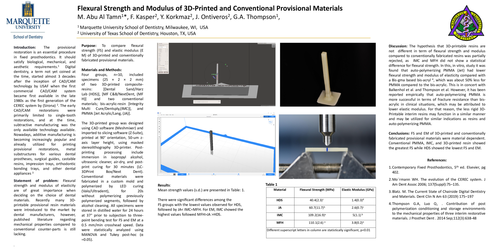
There were significant differences among the FS groups with the lowest values observed for HDS, followed by JA< IMC=MFH. For EM, IMC showed the highest values followed MFH>JA >HDS.
Discussion: The hypothesis that 3D-printable resins are not different in term of flexural strength and modulus compared to conventionally fabricated resins was partially rejected, as IMC and MFH did not show a statistical difference for flexural strength. In this, in vitro study, it was found that auto-polymerizing PMMA (Jet) had lower flexural strength and modulus of elasticity compared with a Bis-gma based bis-acryl 4, which was about 50% less for PMMA compared to the bis-acrylic. This is in concert with Balkenhol et al. and Thompson et al. However, it has been reported empirically that auto-polymerizing PMMA is more successful in terms of fracture resistance than bis-acrylic in clinical situations, which may be attributed to lower elastic modulus. For that reason, the less rigid 3D-Printable interim resins may function in a similar manner and may be utilized for similar indications as resins and auto-polymerizing PMMA.
Conclusions: FS and EM of 3D-printed and conventionally fabricated provisional materials were material dependent. Conventional PMMA, IMC, and 3D-printed resin showed the greatest FS while HDS showed the lowest FS and EM.