66 posters, 2 videos, 1 audios, 2 topics, 162 authors, 49 institutions
ePostersLive by SciGen Technologies S.A. All rights reserved.
American College of Prosthodontists - 2020 ANNUAL SESSION
November 4-7 | Virtual Meeting
104
Zygomatic implants in maxillofacial reconstruction: Systematic review and Resident’s experience in Surgery
Poster Presenter
Authors
Affiliations
Part of Topic
Original Research
Zygomatic Implants in Maxillofacial Reconstruction: Systematic Review
Introduction:
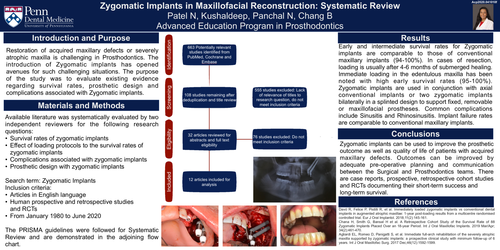
Restoration of acquired maxillary defects or severely atrophic maxilla is challenging in Prosthodontics. The introduction of Zygomatic implants has opened avenues for such challenging situations. The purpose of the study was to evaluate existing evidence regarding survival rates, prosthetic design and complications associated with Zygomatic implants.
Materials and Methods:
Available literature was systematically evaluated by two independent reviewers for the following research questions:
- Survival rates of zygomatic implants
- Effect of loading protocols to the survival rates of zygomatic implants
- Complications associated with zygomatic implants
- Prosthetic design with zygomatic implants
Search term: Zygomatic Implants
Inclusion criteria:
- Articles in English language
- Human prospective and retrospective studies
and RCTs - From January 1980 to June 2020
The PRISMA guidelines were followed for Systematic Review and are demonstrated in the adjoining flow chart.
Results:
Early and intermediate survival rates for Zygomatic implants are comparable to those of conventional maxillary implants (94-100%). In cases of resection, loading is usually after 4-6 months of submerged healing. Immediate loading in the edentulous maxilla has been noted with high early survival rates (95-100%). Zygomatic implants are used in conjunction with axial conventional implants or two zygomatic implants bilaterally in a splinted design to support fixed, removable or maxillofacial prostheses. Common complications include Sinusitis and Rhinosinusitis. Implant failure rates are comparable to conventional maxillary implants.
Conclusion:
Zygomatic implants can be used to improve the prosthetic outcome as well as quality of life of patients with acquired maxillary defects. Outcomes can be improved by adequate pre-operative planning and communication between the Surgical and Prosthodontics teams. There are case reports, prospective, retrospective cohort studies and RCTs documenting their short-term success and long-term survival.