66 posters, 2 videos, 1 audios, 2 topics, 162 authors, 49 institutions
ePostersLive by SciGen Technologies S.A. All rights reserved.
American College of Prosthodontists - 2020 ANNUAL SESSION
November 4-7 | Virtual Meeting

105
A Modeless Approach to Complete Denture Prostheses: A pilot study using a Sphere Coordinate System to Align Digital Scans of Impressions and Capture Maxillomandibular Relationships.
Poster Presenter
Authors
Affiliations
Part of Topic
Original Research
A Modeless Approach to Complete Denture Prostheses: A pilot study using a Sphere Coordinate System to Align Digital Scans of Impressions and Capture Maxillomandibular Relationships
Constantine Stavrinoudis DDS MBS MS, Candice Zemnick DMD MPH MS
Introduction:
Capturing the complete edentulous arch with an intra-oral scanner and properly digitalizing it into an accurate point cloud database has been the current limitation in dentistry. Multiple anatomical landmarks, such as teeth, are absent and capturing movable tissue, such as the vestibule, makes cross stitching scanning a variable of inaccuracy. Edentulous digital workflow for complete denture fabrication has its limitations to digitize including capturing the correct occlusal vertical dimension. Current digital denture workflow trends to capture maxillomandibular relationship is by the use of a centric tray impression or occlusal rim bite registration to merge individual arch STL scans. In this study, we propose an accurate novel approach to digitalize the maxillomandibular relationship by using Zirconia sphere coordinates to align digital scans of the functional impressions of the occlusal rims.
Purpose:
To determine the accuracy of the interocclusal record scanned occlusal rims with zirconia spheres in a triangular formation in relation to the change of articular pin between 3D printed articulation and milled complete dentures that would signify any changes in OVD.
Methods & Materials:
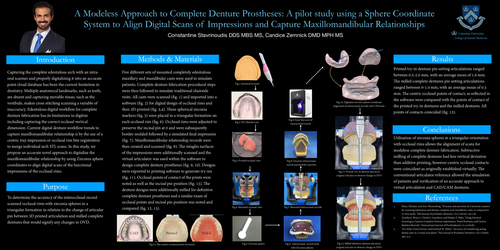
Five different sets of mounted completely edentulous maxillary and mandibular casts were used to simulate patients. Complete denture fabrication procedural steps were then followed to simulate traditional chairside visits. All casts were scanned (fig. 1) and imported into a software (fig. 2) for digital design of occlusal rims and then 3D-printed (fig. 3,4). Three spherical zirconia markers (fig. 5) were placed in a triangular formation on each occlusal rim (fig. 6). Occlusal rims were adjusted to preserve the incisal pin at 0 and were subsequently border-molded followed by a simulated final impression (fig. 7). Maxillomandibular relationship records were then created and scanned (fig. 8). The intaglio surfaces of the impressions were additionally scanned and the virtual articulator was used within the software to design complete denture prostheses (fig. 9, 10). Designs were exported to printing software to generate try-ins (fig. 11). Occlusal points of contact of the prints were noted as well as the incisal pin position (fig. 13). The denture designs were additionally milled for definitive complete denture prostheses and a similar exam of occlusal points and incisal pin position was noted and compared (fig. 12, 13).
Results:
Printed try-in denture pin setting articulations ranged between 0.5-2.0 mm, with an average mean of 1.6 mm. The milled complete dentures pin setting articulations ranged between 0-1.0 mm, with an average mean of 0.5 mm. The centric occlusal points of contact, as reflected in the software were compared with the points of contact of the printed try-in dentures and the milled dentures. All points of contacts coincided (fig. 13).
Utilization of zirconia spheres in a triangular orientation with occlusal rims allows the alignment of scans for modeless complete denture fabrication. Subtractive milling of complete dentures had less vertical deviation than additive printing, however centric occlusal contacts were coincident as originally established virtually. The conventional articulator reference allowed the simulation of patients and verification of an accurate approach to virtual articulation and CAD/CAM dentures.
- Brian, Michael, and Ann Wennerberg. "Trueness and precision of 5 intraoral scanners for scanning edentulous and dentate complete-arch mandibular casts: A comparative in vitro study." The Journal of prosthetic dentistry 122.2 (2019): 129-136.
- Goodacre, Brian J., Charles J. Goodacre, and Nadim Z. Baba. "Using Intraoral Scanning to Capture Complete Denture Impressions, Tooth Positions, and Centric Relation Records." International Journal of Prosthodontics 31.4 (2018).
- Úry, Előd, Cinzia Fornai, and Gerhard W. Weber. "Accuracy of transferring analog dental casts to a virtual articulator." The Journal of Prosthetic Dentistry 123.2 (2020): 305-313.