66 posters, 2 videos, 1 audios, 2 topics, 162 authors, 49 institutions
ePostersLive by SciGen Technologies S.A. All rights reserved.
American College of Prosthodontists - 2020 ANNUAL SESSION
November 4-7 | Virtual Meeting

24
Evaluating the Optimum Angulation in 3D printing
Poster Presenter
Authors
Affiliations
Part of Topic
Original Research
Introduction:
Rapid and automated prototyping of dental materials and restorations in three dimensions (3D) has had a significant impact in all aspects of dentistry in recent years. The enormous progress of digital dentistry in the recent decade is undeniable, especially since the advent of CAD/CAM imaging and milling systems, which have literary created a new modality of clinical dentistry. In brief, in extrusion printing, a material is dispensed from a nozzle with computer controlled movement of a 3-axis stage. The angulation of layering in SLA or DMD-DPP has been a focus of debate. Since there has not been any optimal angle and every manufacturing company have claimed to provide the best angulation for layering regardless of the printing methods. The overarching objective of this work, therefore, was to determine that which angulation used in the printability will be optimum for the accuracy, precision and tolerance.
Materials and Methods:
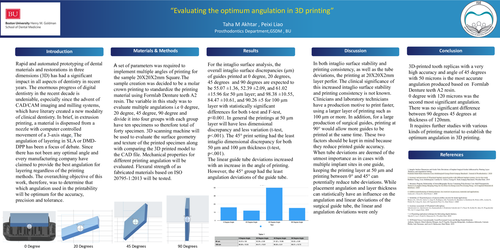
A set of parameters was required to implement multiple angles of printing for the sample 20X20X2mm Square.The sample creation was decided to be a molar crown printing to standardize the printing material using Formlab Denture teeth A2 resin. The variable in this study was to evaluate multiple angulations i.e 0 degree, 20 degree, 45 degree, 90 degree and divide it into four groups with each group have ten specimens so therefore total of forty specimen. 3D scanning machine will be used to evaluate the surface geometry and texture of the printed specimen along with comparing the 3D printed model to the CAD file. Mechanical properties for different printing angulation will be evaluated. Flexural strength of as fabricated materials based on ISO 20795-1:2013 will be tested.
Results:
For the intaglio surface analysis, the overall intaglio surface discrepancies (μm) of guides printed at 0 degree, 20 degrees, 45 degrees and 90 degrees are expected to be 55.07 ±1.36, 52.39 ±2.09, and 61.02 ±15.96 for 50 μm layer; and 98.38 ±10.55, 84.47 ±10.61, and 90.26 ±5 for 100 μm layer with statistically significant differences for both t-test and F-test, p<0.001. In general the printings at 50 μm layer will have less dimensional discrepancy and less variation (t-test, p<.001). The 45° print setting had the least intaglio dimensional discrepancy for both 50 μm and 100 μm thickness (t-test, p<.001).
The linear guide tube deviations increased with an increase in the angle of printing. However, the 45° group had the least angulation deviations of the guide tube.
Discussion:
In both intaglio surface stability and printing consistency, as well as the tube deviations, the printing at 20X20X2mm layer perfor. The clinical significance of this increased intaglio surface stability and printing consistency is not known. Clinicians and laboratory technicians have a production motive to print faster, using a larger layer of printing such as 100 μm or more. In addition, for a large production of surgical guides, printing at 90° would allow more guides to be printed at the same time. These two factors should be kept in mind because they reduce printed guide accuracy. When tube deviations are deemed of the utmost importance as in cases with multiple implant sites in one guide, keeping the printing layer at 50 μm and printing between 0° and 45° can potentially reduce tube deviations. While placement angulation and layer thickness can statistically have an influence on the angulation and linear deviations of the surgical guide tube, the linear and angulation deviations were only
Conclusion:
3D-printed tooth replicas with a very high accuracy and angle of 45 degrees with 50 microns is the most accurate angulation produced based on Formlab Denture teeth A2 resin.
0 degree with 120 microns was the second most significant angulation.
There was no significant difference between 90 degrees 45 degrees at thickness of 120mm.
It requires further studies with various kinds of printing material to establish the optimum angulation in 3D printing.