66 posters, 2 videos, 1 audios, 2 topics, 162 authors, 49 institutions
ePostersLive by SciGen Technologies S.A. All rights reserved.
American College of Prosthodontists - 2020 ANNUAL SESSION
November 4-7 | Virtual Meeting

102
IN VITRO STUDY TO ANALYZE CHANGES IN PRELOAD IN ABUTMENT SCREWS WITH TIGHTENING/LOOSENING ONCE DAILY FOR 15 DAYS
Poster Presenter
Authors
Affiliations
Part of Topic
Original Research
INTRODUCTION:
One of the most common fixed solutions for a missing tooth/ teeth involves implant(s). The reconstruction consists of an abutment and a crown made with metal-ceramic or all-ceramic. An abutment screw is utilized to attach the crown to the implant. Screw loosening is the second most common clinical complication in the implant-prosthesis system (chipping is the first). [1] If clinicians fail to detect worn or loose retaining screws, prosthetic fracture could occur, leading to a more complicated, time consuming and expensive repair. Stripped abutment screw heads could commonly occur due to incorrect driver used to engage the screw head, driver not fully engaged in screw head, driver is stripped or damaged, over-torqueing abutment screw, fatigue of the abutment screw connection due to multiple torqueing attempts or damage to the screw head by clinician using a drill to access the screw.[2] The implant interface design and screw pre-load have a considerable role in maintenance of the seal of an implant system.
AIM:
The aim of this study is to analyze difference in peak torque in clockwise (PCW) and counterclockwise (PCCW) direction after tightening the abutment screws of 4 different implant systems with a torque gauge (Mark 10 Model 3i, Long Island, NY) and sensor. The implant systems used were Nobel Biocare, Straumann, Biohorizons and Astratech. 3D Laser microscope OLS4000 was used to image the connection after a 10 day loading cycle.
MATERIALS AND METHODS:
The implant systems used were Nobel Biocare, Straumann, Biohorizons and
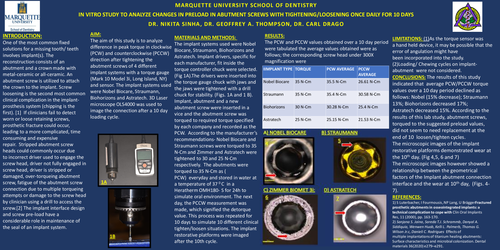
Astratech. Implant drivers, specific for each manufacturer, fit inside the torque controller chuck were selected. (Fig 1A).The drivers were inserted into the torque gauge chuck with jaws and the jaws were tightened with a drill chuck for stability. (Figs. 1A and 1 B). Implant, abutment and a new abutment screw were inserted in a vice and the abutment screw was torqued to required torque specified by each company and recorded as the PCW. According to the manufacturer’s recommendations- Nobel Biocare and Straumann screws were torqued to 35 N-Cm and Zimmer and Astratech were tightened to 30 and 25 N-Cm respectively. The abutments were torqued to 35 N-Cm as ( PCW) everyday and stored in water at a temperature of 37 0 C in a Heratherm OMH180- S for 24h to simulate oral environment. The next day, the PCCW measurement was made, which signified the detorque value. This process was repeated for 10 days to simulate 10 different clinical tighten/loosen situations. The implant restorative platforms were imaged after the 10th cycle.
RESULTS:
The PCW and PCCW values obtained over a 10 day period were tabulated the average values obtained were as follows; the corresponding screw head under 300X magnification were
LIMITATIONS: (1)As the torque sensor was a hand held device, it may be possible that the error of angulation might have been incorporated into the study. (2)Loading/ Chewing cycles on implant- abutment were not considered.
CONCLUSIONS: The results of this study indicated that average PCW/PCCW torque values over a 10 day period declined as follows: Nobel (15% decrease); Straumann 13%; Biohorizons decreased 17%; Astratech decreased 15%. According to the results of this lab study, abutment screws, torqued to the suggested preload values, did not seem to need replacement at the end of 10 loosen/tighten cycles.
The microscopic images of the implant restorative platforms demonstrated wear at the 10th day. (Fig 4,5, 6 and 7)
The microscopic images however showed a relationship between the geometrical factors of the Implant abutment connection interface and the wear at 10th day, (Figs. 4-7).
REFERENCES:
1) S Luterbacher, I Fourmousis, NP Lang, U BräggerFractured prosthetic abutments in osseointegrated implants: a technical complication to cope with Clin Oral Implants Res, 11 (2000), pp. 163-170.
2) Sanjana S. Jaina, Sareda T.J. Schrammb, Danyal A. Siddiquia, Wenwen Huob, Kelli L. Palmerb, Thomas G. Wilson Jr.c, Danieli C. Rodrigues Effects of multiple implantations of titanium healing abutments: Surface characteristics and microbial colonization. Dental materials 36(2020) e279–e291.