66 posters, 2 videos, 1 audios, 2 topics, 162 authors, 49 institutions
ePostersLive by SciGen Technologies S.A. All rights reserved.
American College of Prosthodontists - 2020 ANNUAL SESSION
November 4-7 | Virtual Meeting

85
A new micro-fretting- corrosion (µFC) test system to study dental implant degradation processes.
Poster Presenter
Authors
Apurwa Shukla, Yani Sun, Ghadeer Thalji , Bin Yang , Stephen Campbell , Mathew Mathew
Affiliations
DUMMY2, DUMMY, University of Illinois at Chicago, DUMMY, DUMMY
Part of Topic
Original Research
A New Micro-Fretting- Corrosion (µFC) Test System to Study Dental Implant Degradation Processes
Objective
Recent studies showed that the degradation of dental implants due to the combined effect of masticatory forces and fluid (e.g., saliva) leads to wear (fretting) and corrosion (called tribocorrosion) at implant component interfaces [1-3]. This may lead to bone resorption and implant failure [4].
Although several fretting-corrosion studies were reported, until now, there were no systematic studies with a micromotion of 5µm that had been reported. This is mainly due to the technical difficulties in producing a micromotion fretting test system [3,5]. Therefore, the main objective of this study was to develop a micro fretting-corrosion (µFC) test system to simulate the dental implant interface (Ti6Al4V-Ti6Al4V interface) an od report the initial results
Materials and Experiments
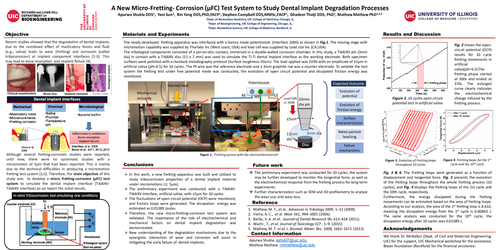
The newly developed fretting apparatus was interfaced with a Gamry made potentiostat (Interface 1000) as shown in Fig.1. The moving stage with micromotion capability was supplied by Thorlabs Inc (West Coast, USA) and the load cell was supplied by Load star Inc (CA, USA).
The tribological components consisted of a pin-on-disc contact, immersed in a double-walled corrosion chamber. In this study, a Ti6Al4V pin (3mm dia) in contact with a Ti6Al4V disc (11 x 7 mm) was used to simulate the Ti-Ti dental implant interface as the working electrode. Both specimen surfaces were polished with a standard metallography protocol (Surface roughness-50um). The load applied was 233N with an amplitude of ±5µm in artificial saliva (pH=6.5) for 10 cycles. The Pt wire was the reference electrode and a 3mm graphite rod was a counter electrode. To validate the test system the fretting test under free potential mode was conducted, the evolution of open circuit potential and dissipated friction energy was monitored.
Results
Fig. 2 shows the open-circuit potential (OCP) results for 10 cycle fretting movements in artificial saliva(pH=6.5). The fretting phase started at 300s and ended at 370s. The enlarged curve clearly indicates the electrochemical change induced by the fretting process.
Fig. 3 & 4. The Fretting loops were generated as a function of displacement and tangential force. Fig. 3 presents the evolution of the fretting loops throughout the whole fretting process (10 cycles), and Fig. 4 displays the fretting loops of the 1st cycle and the 10th cycle, respectively.
Furthermore, the energy dissipated during the fretting movements can be estimated based on the area of fretting loops. According to our analysis, the area of the 1stfretting loop is 8.632, meaning the dissipation energy from the 1st cycle is 0.00863 J. The same analysis was conducted for the 10th cycle, the dissipation energy after 10 cycles was 0.01389 J.