66 posters, 2 videos, 1 audios, 2 topics, 162 authors, 49 institutions
ePostersLive by SciGen Technologies S.A. All rights reserved.
American College of Prosthodontists - 2020 ANNUAL SESSION
November 4-7 | Virtual Meeting
68
Perception of Prosthodontic Residents on Esthetic Outcome of All-Ceramic Single Crown
Poster Presenter
Authors
Affiliations
DUMMY, DUMMY, University at Buffalo School of Dental Medicine
Part of Topic
Original Research
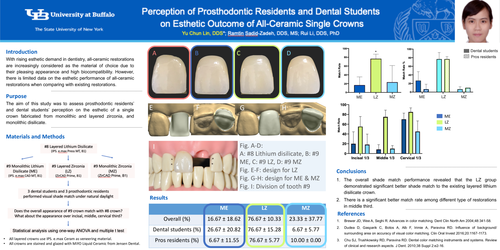
Title: Perception of prosthodontic residents and dental students on esthetic outcome of all-ceramic single crowns.
Authors: Yu Chun Lin, DDS*; Ramtin Sadid-Zadeh, DDS, MS; Rui Li, DDS, PhD
Purpose: The aim of this study was to assess prosthodontic residents’ perception on esthetics outcome of a single crown fabricated from monolithic and layered zirconia, and monolithic lithium disilicate.
Materials and Methods
One maxillary right central incisor crown on a typodont was fabricated using layered pressed lithium disilicate (IPS. e.max; IvoclarVivadent) by an experienced lab technician to match the central incisor of a patient. Subsequently, thirty maxillary left central incisor crowns were designed and fabricated on standard typodont tooth preparations by commercial lab using three different materials, each 10: 1) monolithic zirconia; 2) layered zirconia (ZirCAD Prime; B1) and 3) monolithic lithium disilicate (IPS. e.max CAD MT, B1). Under the single-blind setting, three dental students and three prosthodontic residents participated in the visual shade match. Under natural sunlight, the esthetic outcome was assessed by overall, cervical, middle and incisal shade match of above-mentioned crowns to maxillary right central incisor. Statistical differences between groups were analyzed using one-way ANOVA and multiple t test.
Results:
Conclusions: