66 posters, 2 videos, 1 audios, 2 topics, 162 authors, 49 institutions
ePostersLive by SciGen Technologies S.A. All rights reserved.
American College of Prosthodontists - 2020 ANNUAL SESSION
November 4-7 | Virtual Meeting

67
Relative Accuracy and Patient Compliance of Facial Surface Scanners of Different Cost
Poster Presenter
Authors
Affiliations
Part of Topic
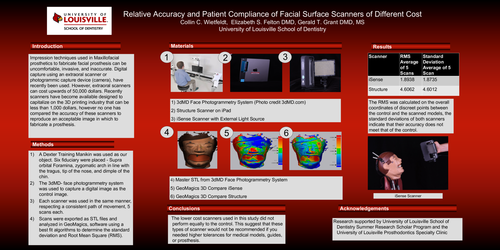
Intro: Impression techniques used in Maxillofacial prosthetics to fabricate facial prosthesis can be uncomfortable, invasive, and inaccurate. Digital capture using an extraoral scanner or photogrammiccapture device (camera), have recently been used. However, extraoral scanners can cost upwards of 50,000 dollars. Recently scanners have become available designed to capitalize on the 3D printing industry that can be less than 1,000 dollars, however no one has compared the accuracy of these scanners to reproduce an acceptable image in which to fabricate a prosthesis.
Methods:1)A Dexter Training Manikin was used as our object. Six fiduciary were placed - Supra orbital Foramina, zygomatic arch in line with the tragus, tip of the nose, and dimple of the chin. 2)The 3dMD- face photogrammetry system was used to capture a digital image as the control image. 3)Each scanner was used in the same manner, respecting a consistent path of movement, 5 scans each. 4)Scans were exported as STL files and analyzed in GeoMagics, software using a best fit algorithms to determine the standard deviation and Root Mean Square (RMS).
Results: The RMS was calculated on the overall coordinates of discreet points between the control and the scanned models, the standard deviations of both scanners indicate that their accuracy does not meet that of the control. Isense:RMS Average of 5 Scans 1.8938 Standard Deviation Average of 5 Scans 1.8735 Structure: RMS Average of 5 Scans 4.6062 Standard Deviation Average of 5 Scans 4.6012
Conclusion: The lower cost scanners used in this study did not perform equally to the control. This suggest that these types of scanner would not be recommended if you needed higher tolerances for medical models, guides, or prosthesis.
Acknowledgments: Research supported by University of Louisville School of Dentistry Summer Research Scholar Program and the University of Louisville Prosthodontics Specialty Clinic