66 posters, 2 videos, 1 audios, 2 topics, 162 authors, 49 institutions
ePostersLive by SciGen Technologies S.A. All rights reserved.
American College of Prosthodontists - 2020 ANNUAL SESSION
November 4-7 | Virtual Meeting
100
Outcome of Adjacent Teeth Next to Restored Implants: A Retrospective Radiographic Analysis
Poster Presenter
Authors
Affiliations
Part of Topic
Introduction
Tooth conditions adjacent to fixed implant prostheses has been reported as open contact and root canal therapy after tooth vitality loss. Several researchers have investigated the prevalence of open contact between implant prostheses and adjacent teeth. A recent study reported that the proximal contact tightness between fixed implant prostheses and adjacent teeth significantly decreased at mesial and distal sites over time, particularly in the mesial. In the same study, the authors showed that major changes occurred in the first 3-month period after crown delivery. Furthermore, open contact may create food impaction that may lead to periodontal defects, recurrent tooth decay, and peri-implant complications. Peri-implant structures are more susceptible to pathosis in comparison to natural teeth. Various physiological factors might contribute to formation of open contacts between teeth and dental implants. Craniofacial growth changes and modifications that occur during adulthood should be emphasized. This is important when treatment planning for implant restorations.
Objectives
This study aims to retrospectively evaluate the conditions of teeth adjacent to restored implant on radiographs to report the prevalence of decay and restorations of adjacent teeth after implant fixed restorations established. An additional aim is to find possible contributing factors of these complications between implant restorations and the adjacent teeth to provide recommendations for possible prevention and treatment of this complication.
Inclusion Criteria: To be included in the study, the subjects must be 22 years of age or older. They must have fixed implant restoration completed at the University of Kentucky, College of Dentistry for at least one year.
Exclusion Criteria: Subjects who did not receive fixed implant restorations at the University of Kentucky, College of Dentistry for at least one year.
Research Procedures: Digital medical record “axiUm” will be used to run a report to identify subjects who received fixed implant restoration treatment at the University of Kentucky, College of Dentistry clinics. Digital radiographs will be reviewed to identify the followings: Age; Gender; Implant site; Implant type; Tooth conditions adjacent to implants: Intact, Direct Restorations, Indirect restorations, Root Canal Therapy, Extraction, Replaced with another implant; date of the change of the conditions. No personal identifications will be used for this study
Results
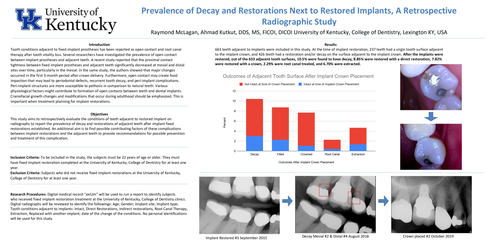
663 teeth adjacent to implants were included in this study. At the time of implant restoration, 237 teeth had a virgin tooth surface adjacent to the implant crown, and 426 teeth had a restoration and/or decay on the surface adjacent to the implant crown. After the implants were restored, out of the 633 adjacent tooth surfaces, 10.5% were found to have decay, 8.85% were restored with a direct restoration, 7.82% were restored with a crown, 2.29% were root canal treated, and 6.70% were extracted.