66 posters, 2 videos, 1 audios, 2 topics, 162 authors, 49 institutions
ePostersLive by SciGen Technologies S.A. All rights reserved.
American College of Prosthodontists - 2020 ANNUAL SESSION
November 4-7 | Virtual Meeting
103
From Bad to Worse: Oral Cancer in a Young Patient with Fanconi Anemia
Poster Presenter
Authors
Affiliations
Part of Topic
Case Presentation
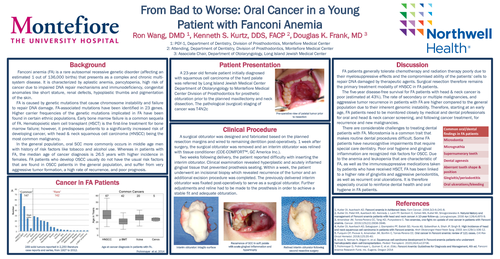
Fanconi anemia (FA) is a rare autosomal recessive genetic disorder (affecting an estimated 1 out of 136,000 births) that presents as a complex and chronic multi-system disease. It is characterized by aplastic anemia, pancytopenia, high risk of cancer due to impaired DNA repair mechanisms and immunodeficiency, congenital anomalies like short stature, renal defects, hypoplastic thumbs and pigmentation of the skin.
FA is caused by genetic mutations that cause chromosome instability and failure to repair DNA damage. FA-associated mutations have been identified in 23 genes. Higher carrier frequencies of the genetic mutations implicated in FA have been found in certain ethnic populations. Early bone marrow failure is a common sequela of FA. Hematopoietic stem cell transplant (HSCT) is the first-line treatment for bone marrow failure; however, it predisposes patients to a significantly increased risk of developing cancer, with head & neck squamous cell carcinoma (HNSCC) being the most common malignancy.
In the general population, oral SCC more commonly occurs in middle age men with history of risk factors like tobacco and alcohol use. Whereas in patients with FA, the median age of cancer diagnosis is 26.5 years with higher incidence in females. FA patients who develop OSCC usually do not have the usual risk factors that are found in OSCC patients in the general population, and suffer from very aggressive tumor formation, a high rate of recurrence, and poor prognosis.
A 23-year old female patient initially diagnosed with squamous cell carcinoma of the hard palate was referred by Long Island Jewish Medical Center Department of Otolaryngology to Montefiore Medical Center Division of Prosthodontics for prosthetic obturation prior to the planned maxillectomy and neck dissection. The pathological (surgical) staging of cancer was T4N2c. A surgical obturator was designed and fabricated based on the planned resection margins and wired to remaining dentition post-operatively. 1 week after surgery, the surgical obturator was removed and an interim obturator was relined with tissue conditioner (COE-COMFORT™, GC America Inc.).
Two weeks following delivery, the patient reported difficulty with inserting the interim obturator. Clinical examination revealed hyperplastic and acutely inflamed gingival tissue that prevented prosthesis seating. Within a week, the patient underwent an incisional biopsy which revealed recurrence of the tumor and an additional excision procedure was completed. The previously delivered interim obturator was fixated post-operatively to serve as a surgical obturator. Further adjustments and reline had to be made to the prosthesis in order to achieve a stable fit and adequate obturation.
FA patients generally tolerate chemotherapy and radiation therapy poorly due to their myelosuppressive effects and the compromised ability of the patients’ cells to repair DNA damaged by therapeutic agents. Surgical resection therefore remains the primary treatment modality of HNSCC in FA patients.
The five-year disease-free survival for FA patients with head & neck cancer is poor (estimated at 43%). The rate of secondary or multiple malignancies, and aggressive tumor recurrence in patients with FA are higher compared to the general population due to their inherent genomic instability. Therefore, starting at an early age, FA patients need to be monitored closely by medical and dental professionals for oral and head & neck cancer screening, and following cancer treatment, for recurrence and new malignancies.
There are considerable challenges to treating dental patients with FA. Microstomia is a common trait that makes routine dental procedures difficult. Some FA patients have neurocognitive impairments that require special care dentistry. Poor oral hygiene and gingival inflammation are recognized risk factors for OSCC. Due to the anemia and leukopenia that are characteristic of FA, as well as the immunosuppressive medications taken by patients who have received HSCT, FA has been linked to a higher rate of gingivitis and aggressive periodontitis, as well as recurrent oral ulcerations. It is therefore especially crucial to reinforce dental health and oral hygiene in FA patients.