66 posters, 2 videos, 1 audios, 2 topics, 162 authors, 49 institutions
ePostersLive by SciGen Technologies S.A. All rights reserved.
American College of Prosthodontists - 2020 ANNUAL SESSION
November 4-7 | Virtual Meeting

65
The Accuracy of Digital Interocclusal Records: A Literature Review
Poster Presenter
Authors
Affiliations
Part of Topic
Original Research
The Accuracy of Digital Interocclusal Records: A Literature Review
Hayam Abouseoud BDS, Mijin Choi DDS, MS, MBA, FACP
Jonathan and Maxine Ferencz Advanced Education Program in Prosthodontics New York University College of Dentistry
Background:
Digital techniques are being utilized more widely for the fabrication of dental restorations.1 Obtaining accurate interocclusal records is an essential part of the success of any final prosthesis.2 The use of digital scanners in obtaining records has been proven to have many advantages. Some of these advantages are its accuracy, efficiency and cost-effectiveness.3 However, the accuracy of digital interocclusal records has not been studied extensively.
Objectives:
The objective of this poster presentation is to review the current literature to determine the accuracy of digital interocclusal record techniques compared to conventional techniques.
Methods:
A PubMed search was performed between 2015 and 2020 using keywords including “virtual interocclusal records”, “digital bite registration”, “digital interocclusal records”, “virtual occlusal records AND scanners”. Selection criteria used were in vivo or in vitro studies that tested the accuracy of digital interocclusal records.
Result:
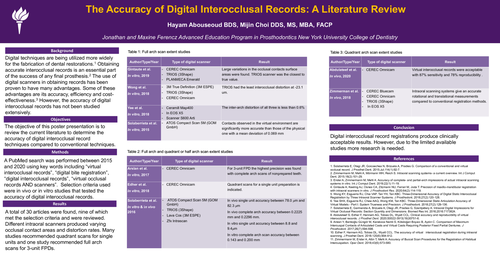
A total of 30 articles were found, nine of which met the selection criteria and were reviewed. Different intraoral scanners produced varying occlusal contact areas and distortion rates. Many studies recommended quadrant scans for single units and one study recommended full arch scans for 3-unit FPDs.
Conclusion :
Digital interocclusal record registrations produce clinically acceptable results. However, due to the limited available studies, more research is needed.