66 posters, 2 videos, 1 audios, 2 topics, 162 authors, 49 institutions
ePostersLive by SciGen Technologies S.A. All rights reserved.
American College of Prosthodontists - 2020 ANNUAL SESSION
November 4-7 | Virtual Meeting
64
Current Status on Zygomatic Implants: A Literature Review
Poster Presenter
Authors
Affiliations
Part of Topic
Original Research
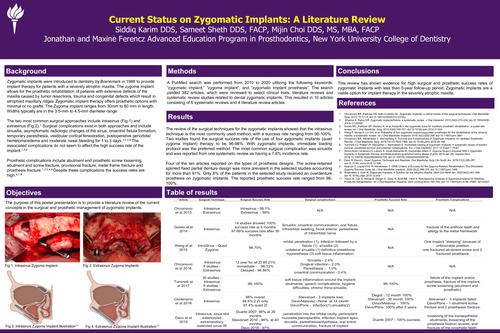
Zygomatic implants were introduced to dentistry by Branemark in 1988 to provide implant therapy for patients with a severely atrophic maxilla. The zygoma implant allows for the prosthetic rehabilitation of patients with extensive defects of the maxilla caused by tumor resections, trauma and congenital defects which result in atrophied maxillary ridges. Zygomatic implant therapy offers prosthetic options with minimal or no grafts. The Zygoma implant ranges from 30mm to 60 mm in length. Widths typically are in the 3.5-mm to 4.5-mm diameter range.
The two most common surgical approaches include intrasinus (Fig.1) and extrasinus (Fig.2).1 Surgical complications exist in both approaches and include sinusitis, asymptomatic radiologic changes of the sinus, oroantral fistula formation, temporary paresthesia, vestibular cortical fenestration, postoperative periorbital hematoma/edema and moderate nasal bleeding for 1 to 3 days.1,2,3,6 The associated complications do not seem to affect the high success rate of the implant.1,3,6
Prosthetic complications include abutment and prosthetic screw loosening, abutment and screw fracture, provisional fracture, metal frame fracture and prosthesis fracture.1,2,3,4,6 Despite these complications the success rates are high.6,7,8
The purpose of this poster presentation is to provide a literature review of the current concepts in the surgical and prosthetic management of zygomatic implants.
A PubMed search was performed from 2010 to 2020 utilizing the following keywords: “zygomatic implant,” “zygoma implant”, and “zygomatic implant prosthesis”. The search yielded 382 articles, which were reviewed to select clinical trials, literature reviews and systematic review studies related to dental zygomatic implants. This resulted in 10 articles consisting of 6 systematic reviews and 4 literature review articles.
The review of the surgical techniques for the zygomatic implants showed that the intrasinus technique is the most commonly used method, with a success rate ranging from 96-100%. Two studies found the surgical success rate of the use of four zygomatic implants (quad zygoma implant) therapy to be 96-98%. With zygomatic implants, immediate loading protocol was the preferred method. The most common surgical complication was sinusitis and was reported from one systematic review as having a 7.6% incidence rate.
Four of the ten articles reported on the types of prosthesis designs. The screw-retained splinted fixed partial denture design was more prevalent in the selected studies accounting for more than 91%. Only 8% of the patients in the selected study received an overdenture prosthesis on zygomatic implants. The reported prosthetic success rate ranged from 96-100%.
This review has shown evidence for high surgical and prosthetic success rates of zygomatic implants with less than 5-year follow-up period. Zygomatic implants are a viable option for implant therapy in the severely atrophic maxilla.