66 posters, 2 videos, 1 audios, 2 topics, 162 authors, 49 institutions
ePostersLive by SciGen Technologies S.A. All rights reserved.
American College of Prosthodontists - 2020 ANNUAL SESSION
November 4-7 | Virtual Meeting

63
Retention force provided by custom-made and native locator abutments
Poster Presenter
Authors
Affiliations
Part of Topic
Original Research
Retention Force Provided by Custom-Made and Native Locator Abutments
H. Ali, BDS, MS; S. Makowka, MS; R. Sadid-Zadeh , DDS, MS
OBJECTIVES
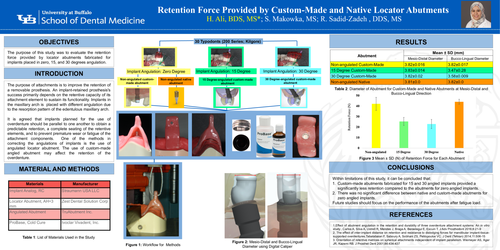
The purpose of this study was to evaluate the retention force provided by locator abutments fabricated for implants placed in zero, 15, and 30 degrees angulation.
INTRODUCTION
The purpose of attachments is to improve the retention of a removable prosthesis. An implant-retained prosthesis's success primarily depends on the retentive capacity of its attachment element to sustain its long-term functionality. (2) The abutment angulation is one of the important factors that might affect the retention of the over denture. It has been reported that angle has an effect upon the retention of gold matrices, but not for titanium matrices. (3) Clinicians have stated that implants planned for use with overdentures must be parallel to one another to obtain predictable attachment retention and complete seating of the retentive elements and to prevent premature wear or fatigue of the involved components. Due to the bone loss pattern of maxillary and mandibular arches, implant placement in zero angulation may not be possible. The angled implant placement may require custom-made angled abutment, leading to unfavorable prosthesis retention.
MATERIAL AND METHODS
Thirty typodonts were used to place 30 implant analogs (Strawman; Bone level RC) in 3 angulations of zero, 15, and 30 degrees (10 each) using 3 custom made jigs. Models were scanned with a desktop scanner (D2000;3Shape A/S) while a TruScan Body (Compatible with Strawman Bone Level RC, TruAbutmentInc) was mounted on the analogs. The abutments were designed using a design software (Dental System; 3Shape A/S) to the same height as a native non-angulated abutment with 3-mm gingival height; then, they were manufactured (TruAbutment Inc). Native abutments (Locator, 3mm GH; Straumann) for zero-degree models were used as the control group. Auto-polymerized PMMA (ProBase Cold; Ivoclar Vivadent) was used to fabricate the custom-made denture base. Abutments were torqued at 35 Ncm using a torque wrench (Straumann). Then, denture caps with black processing males were placed on the abutments, and an auto-polymerizing resin (ProBase Cold; Ivoclar Vivadent) was used to pick up the location of abutments in a custom-made denture base. A clear nylon replacement male was used to replace the processing male. The locators' diameter was measured 3 times at MB and BL dimensions using a digital caliper (Kobalt). The retention force (N) of the denture base was measured using a universal testing machine (manufacturing). One-way ANOVA and a post hoc test were used to compare the difference between diameter of abutments and retention force with difference angled abutments (p=.05).
CONCLUSION
Within limitations of this study, it can be concluded that:
Future studies should focus on the performance of the abutments after fatigue.
REFERENCES
1.Effect of abutment angulation in the retention and durability of three overdenture attachment systems: An in vitro study
2. The effect of inter-implant distance on retention and resistance to dislodging forces for mandibular implant-tissue-supported overdentures.Tabatabaian F, Saboury A, Sobhani ZS, Petropoulos VC. J Dent (Tehran) 2014;11:506-15.
3. Effect of Implant Angulation upon Retention of Overdenture Attachments. Michael P. Gulizio, MSciDent, MSEd John R. Agar, J. Robert Kelly, and Thomas D. Taylor