66 posters, 2 videos, 1 audios, 2 topics, 162 authors, 49 institutions
ePostersLive by SciGen Technologies S.A. All rights reserved.
American College of Prosthodontists - 2020 ANNUAL SESSION
November 4-7 | Virtual Meeting

56
Effect of Reline Material on Shear Bond Strength of 3D Printable Resins used as Interim Dental Restorations
Poster Presenter
Authors
Wael Zakkour, Amir Nejat, Jorge Palavicini, Jose Briceno, Karen Bruggers
Affiliations
Part of Topic
Original Research
Background:
The introduction of 3D printing technology has had a significant impact on the field of restorative dentistry. Since long term provisional crowns may require alterations in oral cavity, appropriate reline material and technique would be required.
Objective:
To compare the bond strength between the FDA approved 3D printed resins for long term provisional and different available reline materials.
Methods:
Specimens were prepared from three different base materials (including Envision Tech, NextDent, and PMMA) and three different reline materials (Composite Resin, Bis-acryl, and PMMA). 3D printed base materials were bonded with all reline materials, and PMMA bases were bonded to PMMA reline material which served as the control group. Specimens were subjected to shear bond strength (SBS) test. SEM analysis was performed for all samples in order to compare the type of fracture between different material. Significance level for statistical analysis was set at 95%.
Results:
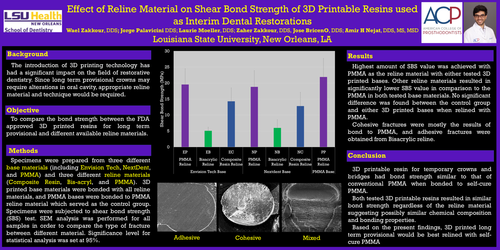
Highest amount of SBS value was achieved with PMMA as the reline material with either tested 3D printed bases. Other reline materials resulted in significantly lower SBS value in comparison to the PMMA in both tested base materials. No significant difference was found between the control group and either 3D printed bases when relined with PMMA.
Cohesive fractures were mostly the results of bond to PMMA, and adhesive fractures were obtained from Bisacrylic reline.
Conclusion:
3D printable resin for temporary crowns and bridges had bond strength similar to that of conventional PMMA when bonded to self-cure PMMA.
Both tested 3D printable resins resulted in similar bond strength regardless of the reline material suggesting possibly similar chemical composition and bonding properties.
Based on the present findings, 3D printed long term provisional would be best relined with self-cure PMMA