66 posters, 2 videos, 1 audios, 2 topics, 162 authors, 49 institutions
ePostersLive by SciGen Technologies S.A. All rights reserved.
American College of Prosthodontists - 2020 ANNUAL SESSION
November 4-7 | Virtual Meeting

54
Effect of Firing Cycle and Etching Condition of Zirconia Reinforced Li2O-SiO2 Glass Ceramics on Tensile Bond Strength with Resin Cement
Poster Presenter
Authors
Mohammed Moeeduddin Ahmed, Dan Nathanson, Hiroshi Hirayama, Yuwei Fan
Affiliations
Part of Topic
Original Research
Title: Effect of Firing Cycle and Etching Condition of Zirconia Reinforced Li2O-SiO2 Glass Ceramics on
Tensile Bond Strength with Resin Cement
Objectives:
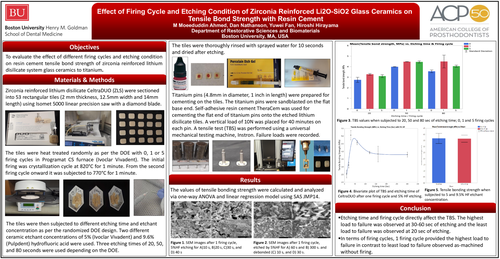
To evaluate the effect of different firing cycles and etching condition on resin cement tensile bond strength of zirconia reinforced lithium disilicate system glass ceramics to titanium.
Materials & Methods:
Zirconia reinforced lithium disilicate CeltraDUO (ZLS) were sectioned into 53 rectangular tiles (2 mm thickness, 12.5mm width and 14mm length) using Isomet 5000 linear precision saw with a diamond blade.
The tiles were heat treated randomly as per the DOE with 0, 1 or 5 firing cycles in Programat CS furnace (Ivoclar Vivadent). The initial firing was crystallization cycle at 820°C for 1 minute. From the second firing cycle onward it was subjected to 770°C for 1 minute.
The tiles were then subjected to different etching time and etchant concentration as per the randomized DOE design. Two different ceramic etchant concentrations of 5% (Ivoclar Vivadent) and 9.6% (Pulpdent) hydrofluoric acid were used. Three etching times of 20, 50, and 80 seconds were used depending on the DOE.
The tiles were thoroughly rinsed with sprayed water for 10 seconds and dried after etching.
Titanium pins (4.8mm in diameter, 1 inch in length) were prepared for cementing on the tiles. The titanium pins were sandblasted on the flat base end. Self-adhesive resin cement TheraCem was used for cementing the flat end of titanium pins onto the etched lithium disilicate tiles. A vertical load of 10N was placed for 40 minutes on each pin. A tensile test (TBS) was performed using a universal mechanical testing machine, Instron.
Failure loads were recorded.