66 posters, 2 videos, 1 audios, 2 topics, 162 authors, 49 institutions
ePostersLive by SciGen Technologies S.A. All rights reserved.
American College of Prosthodontists - 2020 ANNUAL SESSION
November 4-7 | Virtual Meeting
41
Influence of Crown to Implant Ratio on Crestal Marginal Bone Level in Different Bone Densities
Poster Presenter
Authors
Affiliations
Part of Topic
Original Research
Influence of Crown to Implant Ratio on Crestal Marginal Bone Level in Different Bone Densities
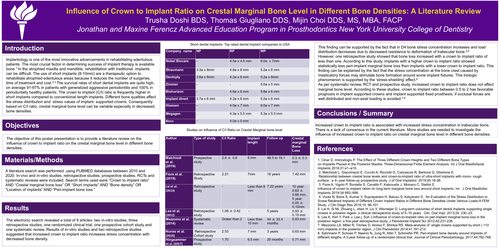
Implantology is one of the most innovative advancements in rehabilitating edentulous patients. The most crucial factor in determining success of implant therapy is available bone.1 In the atrophied maxilla and mandible, rehabilitation with traditional implants can be difficult. The use of short implants (8-10mm) are a therapeutic option to rehabilitate atrophied edentulous areas because it reduces the number of surgeries, time of treatment and cost.2,3 The survival rates of short dental implants are quite high, on average 91-97% in patients with generalized aggressive periodontitis and 100% in periodontally healthy patients. The crown to implant (C/I) ratio is frequently higher in short implants compared to conventional length implants. Different bone qualities affect the stress distribution and stress values of implant- supported crowns. Consequently based on C/I ratio, crestal marginal bone level can be variable especially in decreased bone densities.
The objective of this poster presentation is to provide a literature review on the influence of crown to implant ratio on the crestal marginal bone level in different bone densities.
A literature search was performed using PUBMED databases between 2010 and 2020. In-vivo and in-vitro studies, retrospective studies, prospective studies, RCTs and systematic reviews were included. Search terms used were “Crown to implant ratio” AND “Crestal marginal bone loss” OR “Short implants” AND “Bone density” OR “Location of implants” AND “Peri-implant bone loss.”
The electronic search revealed a total of 8 articles: two in-vitro studies, three retrospective studies, one randomized clinical trial, one prospective cohort study and one systematic review. Results of in-vitro studies and two retrospective studies suggested that increased crown to implant ratio increases stress concentration with decreased bone density.
This finding can be supported by the fact that in D4 bone stress concentration increases and load distribution decreases due to decreased resistance to deformation of trabecular bone.4,5
However, one retrospective study showed that bone loss increased with a crown to implant ratio of less than one. According to this study, implants with a higher crown to implant ratio showed statistically less peri-implant marginal bone loss than implants with a lower crown to implant ratio. This finding can be explained by the fact that the stress concentration at the bone crest caused by masticatory forces may stimulate bone formation around some implant fixtures. This biologic phenomenon is supported by the ‘stress-shielding’ effect.6
As per systematic review, RCT and prospective study, increased crown to implant ratio does not affect marginal bone level. According to these studies, crown to implant ratio between 0.5 to 2 has favorable prognosis in implant supported crowns and implant supported fixed prosthesis, if occlusal forces are well distributed and non-axial loading is avoided.7,8
Increased crown to implant ratio is associated with increased stress concentration in trabecular bone. There is a lack of consensus in the current literature. More studies are needed to investigate the influence of increased crown to implant ratio on crestal marginal bone level in different bone densities.