66 posters, 2 videos, 1 audios, 2 topics, 162 authors, 49 institutions
ePostersLive by SciGen Technologies S.A. All rights reserved.
American College of Prosthodontists - 2020 ANNUAL SESSION
November 4-7 | Virtual Meeting

25
Evaluation of implant abutment screw tightening protocols on reverse tightening values: an in-vitro study
Poster Presenter
Authors
Abdullah Alnasser, Chandur Wadhwani , Todd Schoenbaum, Mathew Kattadiyil
Affiliations
Part of Topic
Original Research
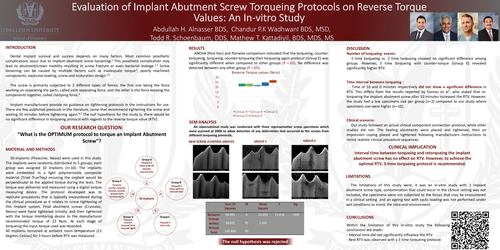
Evaluation of Implant Abutment Screw Torqueing Protocols on Reverse Torque Values: An In-vitro Study
INTRODUCTION
Dental implant survival and success depends on many factors. Most common prosthetic complications occur due to implant abutment screw loosening.1 This prosthetic complication may lead to abutment/crown mobility resulting in screw fracture or even bacterial leakage.1,2 Screw loosening can be caused by multiple factors such as inadequate torque3, poorly machined components, excessive loading, screw and restoration design.4,5
The screw is primarily subjected to 2 different types of forces; the first one being the force working on separating the parts, called joint separating force, and the other is the force keeping the components together, called clamping force.4
Implant manufacturers provide no guidance on tightening protocols in the instructions for use. There are few published protocols in the literature, some that recommend tightening the screw and waiting 10 minutes before tightening again.6,7 The null hypothesis for the study is, there would be no significant difference in torqueing protocol with regards to the reverse torque value (RTV).