193 posters, 19 videos, 10 audios, 3 topics, 28 sessions, 714 authors, 278 institutions
ePostersLive by SciGen Technologies S.A. All rights reserved.
9th World Congress on Vascular Access 2026
15 - 17 April, 2026 | Valencia, Spain

240
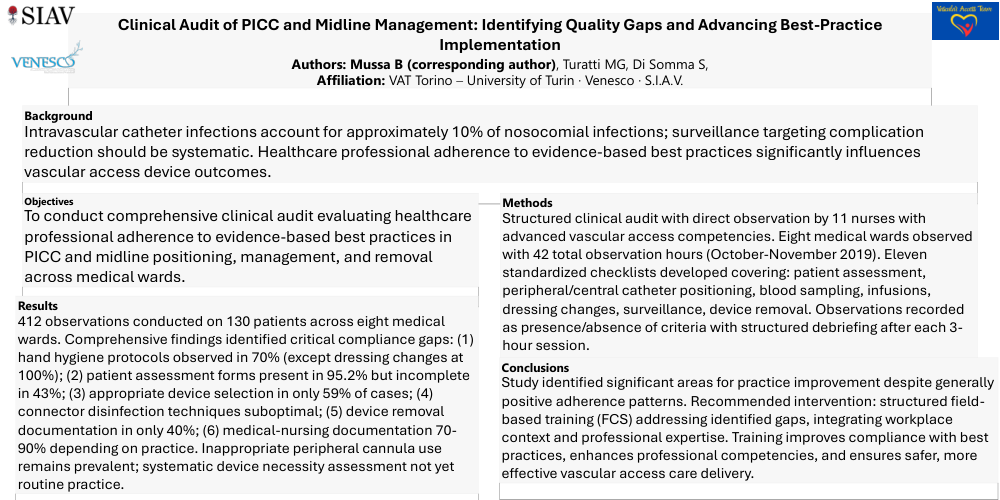
Clinical Audit of PICC and Midline Management: Identifying Quality Gaps and Advancing Best-Practice Implementation
Poster Presenter
Part of Topic
Original clinical study
Video
Text: *Title:* Clinical Audit of PICC and Midline Management: Identifying Quality Gaps and Advancing Best-Practice Implementation
*Background:* Intravascular catheter infections account for approximately 10% of nosocomial infections; surveillance targeting complication reduction should be systematic. Healthcare professional adherence to evidence-based best practices significantly influences vascular access device outcomes.
*Objective:* To conduct comprehensive clinical audit evaluating healthcare professional adherence to evidence-based best practices in PICC and midline positioning, management, and removal across medical wards.
*Methods:* Structured clinical audit with direct observation by 11 nurses with advanced vascular access competencies. Eight medical wards observed with 42 total observation hours (October-November 2019). Eleven standardized checklists developed covering: patient assessment, peripheral/central catheter positioning, blood sampling, infusions, dressing changes, surveillance, device removal. Observations recorded as presence/absence of criteria with structured debriefing after each 3-hour session.
*Results:* 412 observations conducted on 130 patients across eight medical wards. Comprehensive findings identified critical compliance gaps: (1) hand hygiene protocols observed in 70% (except dressing changes at 100%); (2) patient assessment forms present in 95.2% but incomplete in 43%; (3) appropriate device selection in only 59% of cases; (4) connector disinfection techniques suboptimal; (5) device removal documentation in only 40%; (6) medical-nursing documentation 70-90% depending on practice. Inappropriate peripheral cannula use remains prevalent; systematic device necessity assessment not yet routine practice.
*Conclusions:* Study identified significant areas for practice improvement despite generally positive adherence patterns. Recommended intervention: structured field-based training (FCS) addressing identified gaps, integrating workplace context and professional expertise. Training improves compliance with best practices, enhances professional competencies, and ensures safer, more effective vascular access care delivery.