193 posters, 19 videos, 10 audios, 3 topics, 28 sessions, 714 authors, 278 institutions
ePostersLive by SciGen Technologies S.A. All rights reserved.
9th World Congress on Vascular Access 2026
15 - 17 April, 2026 | Valencia, Spain

101
VascularCare: A Mobile App Proposal for Integrated Home Management of Vascular Access Devices
Poster Presenter
Authors
Baudolino Mussa, Anna Bernocco, Federica Intermite, Stefania Silvestro, Angela Restivo
Affiliations
Part of Topic
Original clinical study
Video
Title:
VascularCare: A Mobile App Proposal for Integrated Home Management of Vascular Access Devices
Background: Patients with peripherally inserted central catheters, midlines, ports and other vascular access devices increasingly receive complex therapies at home, often with fragmented documentation and limited specialist support. Mobile health solutions can enhance continuity of information, empower patients and caregivers, and support expert nurses in preventing device-related complications.
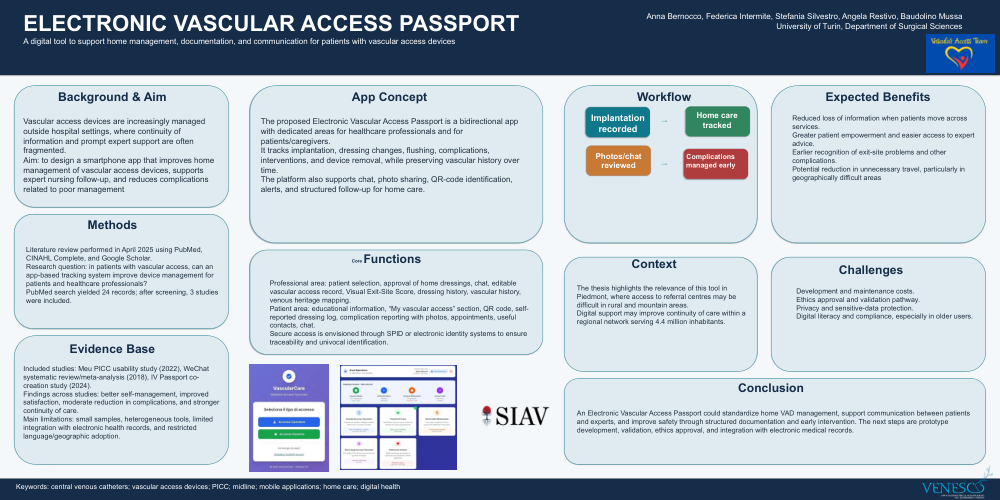
Aim: To propose “VascularCare”, a mobile application for integrated home management of vascular access devices, enabling shared, real-time tracking of device data and bidirectional communication between patients, caregivers and vascular access specialists.
Methods: A narrative literature review was conducted in PubMed, CINAHL Complete and Google Scholar to identify existing apps for vascular access management. Only three relevant studies were found, showing that dedicated apps (e.g. WeChat-based PICC follow-up, MeuPICC, IV Passport) improved self-management, reduced complications and enhanced satisfaction, despite usability, privacy and implementation challenges. Based on these findings and current GAVeCeLT and INS standards, a conceptual design of VascularCare was developed.
Project: VascularCare is a smartphone app organized into two main interfaces: a professional area and a patient/caregiver area. Core functions include: digital “vascular access passport” (device type, site, dates, complications, previous lines), structured documentation of dressings and exit-site scores, photo-based teleconsultation, automated reminders for dressing changes and follow-up, DIVA and venous mapping records, and curated educational content on VAD care and warning signs. Secure access via SPID/CIE and planned integration with electronic health records are envisaged.