193 posters, 19 videos, 10 audios, 3 topics, 28 sessions, 714 authors, 278 institutions
ePostersLive by SciGen Technologies S.A. All rights reserved.
9th World Congress on Vascular Access 2026
15 - 17 April, 2026 | Valencia, Spain

238
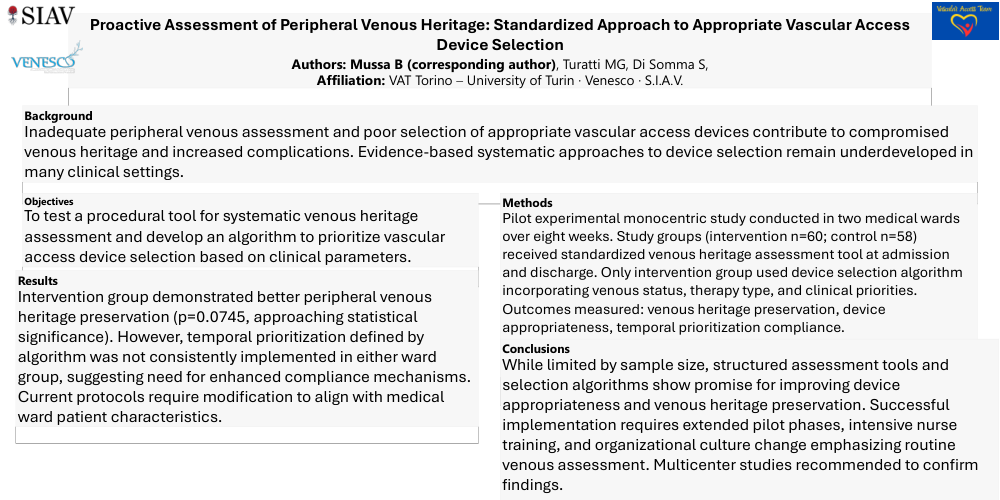
Proactive Assessment of Peripheral Venous Heritage: Standardized Approach to Appropriate Vascular Access Device Selection
Poster Presenter
Part of Topic
Original clinical study
Video
**Title:** Proactive Assessment of Peripheral Venous Heritage: Standardized Approach to Appropriate Vascular Access Device Selection
**Background:** Inadequate peripheral venous assessment and poor selection of appropriate vascular access devices contribute to compromised venous heritage and increased complications. Evidence-based systematic approaches to device selection remain underdeveloped in many clinical settings.
**Objective:** To test a procedural tool for systematic venous heritage assessment and develop an algorithm to prioritize vascular access device selection based on clinical parameters.
**Methods:** Pilot experimental monocentric study conducted in two medical wards over eight weeks. Study groups (intervention n=60; control n=58) received standardized venous heritage assessment tool at admission and discharge. Only intervention group used device selection algorithm incorporating venous status, therapy type, and clinical priorities. Outcomes measured: venous heritage preservation, device appropriateness, temporal prioritization compliance.
**Results:** Intervention group demonstrated better peripheral venous heritage preservation (p=0.0745, approaching statistical significance). However, temporal prioritization defined by algorithm was not consistently implemented in either ward group, suggesting need for enhanced compliance mechanisms. Current protocols require modification to align with medical ward patient characteristics.
**Conclusions:** While limited by sample size, structured assessment tools and selection algorithms show promise for improving device appropriateness and venous heritage preservation. Successful implementation requires extended pilot phases, intensive nurse training, and organizational culture change emphasizing routine venous assessment. Multicenter studies recommended to confirm findings.
**Keywords:** Vascular access, venous heritage, device selection, assessment tool, algorithm, quality improvement