193 posters, 19 videos, 10 audios, 3 topics, 28 sessions, 714 authors, 278 institutions
ePostersLive by SciGen Technologies S.A. All rights reserved.
9th World Congress on Vascular Access 2026
15 - 17 April, 2026 | Valencia, Spain

239
Extended Dressing Intervals for PICC Management in Oncohematologic Patients: Safety and Patient Satisfaction Study
Poster Presenter
Part of Topic
Original clinical study
Video
**Title:** Extended Dressing Intervals for PICC Management in Oncohematologic Patients: Safety and Patient Satisfaction Study
**Background:** Current guidelines recommend PICC dressing changes every 7 days. Extended intervals (10-14 days) may improve patient satisfaction and reduce healthcare facility visits without compromising safety, particularly in patients undergoing chemotherapy with predictable therapy schedules.
**Objective:** To evaluate whether extending PICC dressing and flush intervals to 10 or 14 days increases patient satisfaction while maintaining device safety and preventing complications.
**Methods:** Prospective observational study of 26 oncohematologic patients followed for one month with structured monitoring protocol. Primary outcomes: skin integrity, dressing adherence, device patency, patient satisfaction. Secondary outcomes: infection rates, complication incidence. Only 16 patients completed observation period; longitudinal data obtained (3-5 evaluations per patient).
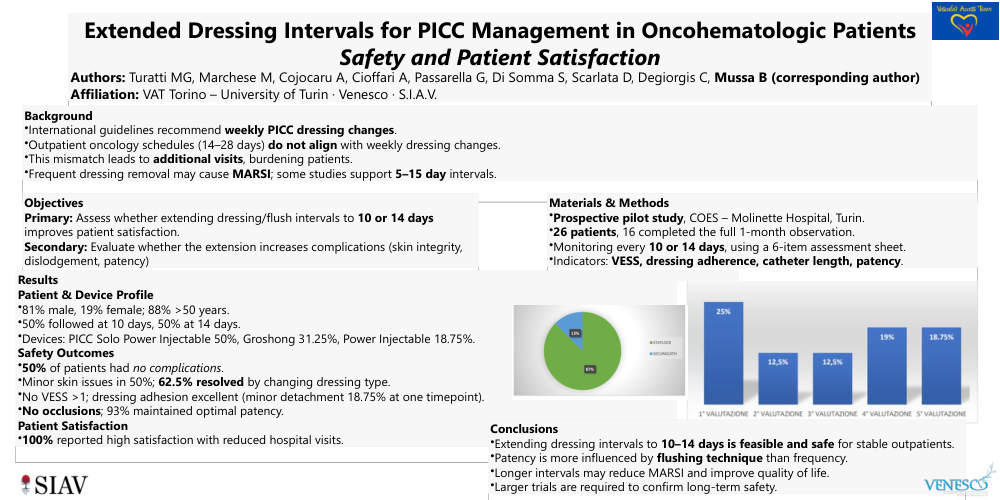
**Results:** Fifty percent of patients experienced no complications during observation period. Of 50% experiencing issues, 62.5% resolved with alternative dressing strategies. Dressing adherence remained optimal (>93%) through evaluation 3, with 100% adherence in final evaluations. Exit site assessment remained favorable (scores 0-1). No significant differences observed between 10-day and 14-day intervals. Data lacked statistical significance due to sample limitations.
**Conclusions:** Preliminary findings suggest extended dressing intervals may be feasible without increased complications, potentially improving patient convenience and reducing unnecessary facility visits. However, data are not generalizable; adequately powered multicenter trials are essential before implementation of extended protocols. Findings may allow care synchronization with chemotherapy cycles.
**Keywords:** PICC, dressing changes, extended intervals, patient satisfaction, oncology, ambulatory care