1,267 posters, 47 videos, 13 topics, 4 sessions, 853 authors
ePostersLive by SciGen Technologies S.A. All rights reserved.
SOHO 2026 Annual Meeting
September 9 - 12, 2026 | George R. Brown Convention Center, Houston, Texas

MDS - 1074
A Phase 2 Open-Label Study to Assess the Tolerability of Ianalumab (VAY736) With Investigator's-Choice Thrombopoietin Receptor Agonist in Patients With Primary Immune Thrombocytopenia: VAY2EXPLORE Study Design
Poster Presenter
Authors
Part of Topic
Myelodysplastic Syndromes (MDS)
Poster MDS-1074
Mary Lisha Paul | mary_lisha.paul@novartis.com
A phase 2 open-label studyto assess the tolerability ofianalumab (VAY736) withinvestigator’s choice thrombopoietin receptor agonist in patients with primary immune thrombocytopenia: VAY2EXPLORE studydesign
David J. Kuter, MD, DPhil,1 Cindy Neunert, MD,2 Gerald A. Soff, MD,3 Shruti Chaturvedi, MD,4 Sandhya R. Panch, MD, MPH,5 Mary Lisha Paul, MD,6 Anumaxine Lincy Geevarghese, MD,6 Jincy Paulose,MD,6 Sarah DiDominck Costa, PharmD,6 Hanny Al-Samkari, MD,1 Adam Cuker, MD7
1Massachusetts General Hospital, Harvard Medical School, Boston, MA, USA; 2Columbia University, Irving Medical Center, New York, NY, USA; 3University of Miami, Sylvester Comprehensive Cancer Center, Miami, FL,USA; 4Johns Hopkins University School of Medicine, Baltimore, MD, USA; 5Fred Hutchinson Cancer Center, Seattle, WA, USA; 6Novartis Pharmaceuticals Corporation, East Hanover, NJ, USA; 7Perelman School of Medicine, University of Pennsylvania, Philadelphia, PA, USA
INTRODUCTION
• ITP is an immune-mediated disease characterized by transient or persistent decrease of platelets and, depending on the degree of thrombocytopenia, increased risk of bleeding1
• Ianalumab is a monoclonal antibody targeting B cells through a novel dual mechanism of action of inhibition of B-cell activation and survival via B-cell activating factor receptor (BAFF-R) blockade and enhanced depletion of B cells via antibody-dependent cellular cytotoxicity (ADCC)2-4
• In the phase 3 VAYHIT2 study (NCT05653219), ianalumab plus the TPO-RA eltrombopag demonstrated significantly prolonged time to treatment failure versus eltrombopag alone5
• VAY2EXPLORE builds on prior ianalumab data in ITP by extending evaluation to investigator’s choice (IC) TPO-RAs in a pretreated population. The study is designed to evaluate the tolerability of ianalumab 9 mg/kg with ongoing TPO-RA, and whether the TPO-RA can be tapered off while maintaining durable response off treatment
OBJECTIVE
• To investigate the tolerability of ianalumab with ongoing IC TPO-RA background treatment in patients with ITP
METHODS
Study Design
• VAY2EXPLORE (NCT07421167) is a phase 2, multicenter, open-label trial to investigate the tolerability of ianalumab with ongoing IC TPO-RA background treatment in adults with ITP previously treated with 1-4 treatments
• Approximately 149 patients with ITP will be enrolled, with 25-60 patients on each IC TPO-RA (eltrombopag, avatrombopag, and romiplostim). The study will also enroll up to 15 patients with Evans Syndrome (ES) in an exploratory cohort
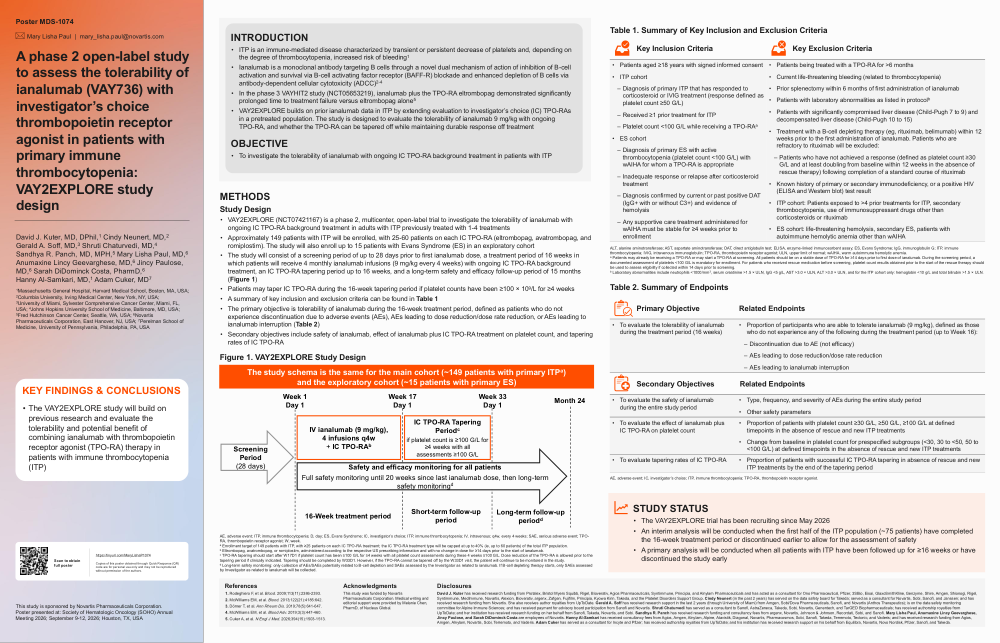
• The study will consist of a screening period of up to 28 days prior to first ianalumab dose, a treatment period of 16 weeks in which patients will receive 4 monthly ianalumab infusions (9 mg/kg every 4 weeks) with ongoing IC TPO-RA background treatment, an IC TPO-RA tapering period up to 16 weeks, and a long-term safety and efficacy follow-up period of 15 months (Figure 1)
• Patients may taper IC TPO-RA during the 16-week tapering period if platelet counts have been ≥100 × 109/L for ≥4 weeks
• A summary of key inclusion and exclusion criteria can be found in Table 1
• The primary objective is tolerability of ianalumab during the 16-week treatment period, defined as patients who do not experience discontinuation due to adverse events (AEs), AEs leading to dose reduction/dose rate reduction, or AEs leading toianalumab interruption (Table 2)
• Secondary objectives include safety of ianalumab, effect of ianalumab plus IC TPO-RA treatment on platelet count, and tapering rates of IC TPO-RA
Figure 1. VAY2EXPLORE Study Design
The study schema is the same for the main cohort (~149 patients with primary ITPa)and the exploratory cohort (~15 patients with primary ES)
Screening Period (28 days)
Week 1 Day 1
IV ianalumab (9 mg/kg), 4 infusions q4w+ IC TPO-RAb
16-Week treatment period
Week 17 Day 1
IC TPO-RA Tapering Periodc if platelet count is ≥100 G/L for≥4 weeks with all assessments ≥100 G/L
Short-term follow-up period
Week 33 Day 1
Long-term follow-upperiodd
Month 24
Safety and efficacy monitoring for all patients
Full safety monitoring until 20 weeks since last ianalumab dose, then long-term safety monitoringd
AE, adverse event; ITP, immune thrombocytopenia; D, day; ES, Evans Syndrome; IC, investigator’s choice; ITP, immune thrombocytopenia; IV, intravenous; q4w, every 4 weeks; SAE, serious adverse event; TPO-RA, thrombopoietin receptor agonist; W, week.
a Enrollment target of 149 patients with ITP, with ≥25 patients on each IC TPO-RA treatment; the IC TPO-RA treatment type will be capped at up to 40% (ie, up to 60 patients) of the total ITP population.
b Eltrombopag, avatrombopag, or romiplostim, administered according to the respective US prescribing information and with no change in dose for ≥14 days prior to the start of ianalumab.
c TPO-RA tapering should start after W17D1 if platelet count has been ≥100 G/L for ≥4 weeks with all platelet count assessments during these 4 weeks ≥100 G/L. Dose reduction of the TPO-RA is allowed prior to the tapering period if clinically indicated. Tapering should be completed by W33D1. However, if the TPO-RA cannot be tapered off by the W33D1 visit, the patient will continue to be monitored in the study.
d Long-term safety monitoring: only collection of AEs/SAEs potentially related to B-cell depletion and SAEs assessed by the Investigator as related to ianalumab. If B-cell depleting therapy starts, only SAEs assessed by Investigator as related to ianalumab will be collected.
Table 1. Summary of Key Inclusion and Exclusion Criteria
Key Inclusion Criteria
• Patients aged ≥18 years with signed informed consent
• ITP cohort
– Diagnosis of primary ITP that has responded to corticosteroid or IVIG treatment (response defined as platelet count ≥50 G/L)
– Received ≥1 prior treatment for ITP
– Platelet count <100 G/L while receiving a TPO-RAa
• ES cohort
– Diagnosis of primary ES with active thrombocytopenia (platelet count <100 G/L) with wAIHA for whom a TPO-RA is appropriate
– Inadequate response or relapse after corticosteroid treatment
– Diagnosis confirmed by current or past positive DAT (IgG+ with or without C3+) and evidence of hemolysis
– Any supportive care treatment administered for wAIHA must be stable for ≥4 weeks prior to enrollment
Key Exclusion Criteria
• Patients being treated with a TPO-RA for >6 months
• Current life-threatening bleeding (related to thrombocytopenia)
• Prior splenectomy within 6 months of first administration of ianalumab
• Patients with laboratory abnormalities as listed in protocolb
• Patients with significantly compromised liver disease (Child-Pugh 7 to 9) and decompensated liver disease (Child-Pugh 10 to 15)
• Treatment with a B-cell depleting therapy (eg, rituximab, belimumab) within 12 weeks prior to the first administration of ianalumab. Patients who are refractory to rituximab will be excluded:
– Patients who have not achieved a response (defined as platelet count ≥30G/L and at least doubling from baseline within 12 weeks in the absence of rescue therapy) following completion of a standard course of rituximab
• Known history of primary or secondary immunodeficiency, or a positive HIV (ELISA and Western blot) test result
• ITP cohort: Patients exposed to >4 prior treatments for ITP, secondary thrombocytopenia, use of immunosuppressant drugs other than corticosteroids or rituximab
• ES cohort: life-threatening hemolysis, secondary ES, patients with autoimmune hemolytic anemia other than wAIHA
ALT, alanine aminotransferase; AST, aspartate aminotransferase; DAT, direct antiglobulin test; ELISA, enzyme-linked immunosorbent assay; ES, Evans Syndrome; IgG, immunoglobulin G; ITP, immunethrombocytopenia; IVIG, intravenous immunoglobulin; TPO-RA, thrombopoietin receptor agonist; ULN, upper limit of normal; wAIHA, warm autoimmune hemolytic anemia.
a Patients may already be receiving a TPO-RA or may start a TPO-RA at screening. All patients should be on a stable dose of TPO-RA for ≥14 days prior to first dose of ianalumab. During the screening period, a documented assessment of platelets <100 G/L is mandatory for enrollment. For patients who received rescue medication before screening, platelet count results obtained prior to the start of the rescue therapy should be used to assess eligibility if collected within 14 days prior to screening.
b Laboratory abnormalities include neutrophils <1000/mm3, serum creatinine >1.5 × ULN, IgG <5 g/L, AST >3.0 × ULN, ALT >3.0 × ULN, and for the ITP cohort only: hemoglobin <10 g/L and total bilirubin >1.5 × ULN.
Table 2. Summary of Endpoints
Primary Objective
• To evaluate the tolerability of ianalumab during the treatment period (16 weeks)
Related Endpoints
• Proportion of participants who are able to tolerate ianalumab (9 mg/kg), defined as those who do not experience any of the following during the treatment period (up to Week 16):
– Discontinuation due to AE (not efficacy)
– AEs leading to dose reduction/dose rate reduction
– AEs leading to ianalumab interruption
Secondary Objectives
• To evaluate the safety of ianalumabduring the entire study period
• To evaluate the effect of ianalumab plusIC TPO-RA on platelet count
• To evaluate tapering rates of IC TPO-RA
Related Endpoints
• Type, frequency, and severity of AEs during the entire study period
• Other safety parameters
• Proportion of patients with platelet count ≥30 G/L, ≥50 G/L, ≥100 G/L at defined timepoints in the absence of rescue and new ITP treatments
• Change from baseline in platelet count for prespecified subgroups (<30, 30 to <50, 50 to <100 G/L) at defined timepoints in the absence of rescue and new ITP treatments
• Proportion of patients with successful IC TPO-RA tapering in absence of rescue and new ITP treatments by the end of the tapering period
AE, adverse event; IC, investigator’s choice; ITP, immune thrombocytopenia; TPO-RA, thrombopoietin receptor agonist.
STUDY STATUS
• The VAY2EXPLORE trial has been recruiting since May 2026
• An interim analysis will be conducted when the first half of the ITP population (~75 patients) have completed the 16-week treatment period or discontinued earlier to allow for the assessment of safety
• A primary analysis will be conducted when all patients with ITP have been followed up for ≥16 weeks or have discontinued the study early
KEY FINDINGS & CONCLUSIONS
• The VAY2EXPLORE study will build on previous research and evaluate the tolerability and potential benefit of combining ianalumab with thrombopoietin receptor agonist (TPO-RA) therapy in patients with immune thrombocytopenia (ITP)
References
1. Rodeghiero F, et al. Blood. 2009;113(11):2386-2393.
2. McWilliams EM, et al. Blood. 2013;122(21):4185:642.
3. Dörner T, et al. Ann Rheum Dis. 2019;78(5):641-647.
4. McWilliams EM, et al. Blood Adv. 2019;3(3):447-460.
5. Cuker A, et al. N Engl J Med. 2026;394(15):1503-1513.
Acknowledgments
This study was funded by Novartis Pharmaceuticals Corporation. Medical writing andeditorial support were provided by Melanie Chen,PharmD, of Nucleus Global.
Disclosures
David J. Kuter has received research funding from Protalex, Bristol Myers Squibb, Rigel, Bioverativ, Agios Pharmaceuticals, Syntimmune, Principia, and Alnylam Pharmaceuticals and has acted as a consultant for Ono Pharmaceutical, Pfizer, 3SBio, Eisai, GlaxoSmithKline, Genzyme, Shire, Amgen, Shionogi, Rigel, Syntimmune, MedImmune, Novartis, Alexion, Bioverativ, argenx, Zafgen, Fujifilm, Principia, Kyowa Kirin, Takeda, and the Platelet Disorders Support Group. Cindy Neunert (in the past 2 years) has served on the data safety board for Takeda; served as a consultant for Novartis, Sobi, Sanofi, and Janssen; and has received research funding from Novartis. She also receives author royalties from UpToDate. Gerald A. Soff has received research support in the last 2 years (through University of Miami) from Amgen, Sobi/Dova Pharmaceuticals, Sanofi, and Novartis (Anthos Therapeutics); is on the data safety monitoring committee for Alpine Immune Sciences; and has received payment for advisory board participation from Sanofi and Novartis. Shruti Chaturvedi has served as a consultant to Sanofi, AstraZeneca, Takeda, Sobi, Novartis, Genentech, and TarGED Biopharmaceuticals; has received authorship royalties from UpToDate; and her institution has received research funding on her behalf from Sanofi, Takeda, Novartis, and Sobi. Sandhya R. Panch has received research funding and consultancy fees from argenx, Novartis, Johnson & Johnson, Recordati, Sobi, and Sanofi. Mary Lisha Paul, Anumaxine Lincy Geevarghese,Jincy Paulose, and Sarah DiDominck Costa are employees of Novartis. Hanny Al-Samkari has received consultancy fees from Agios, Amgen, Alnylam, Alpine, Atavistik, Diagonal, Novartis, Pharmacosmos, Sobi, Sanofi, Takeda, Terremoto, Tectonic, and Vaderis; and has received research funding from Agios, Amgen, Alnylam, Novartis, Sobi, Terremoto, and Vaderis. Adam Cuker has served as a consultant for Incyte and Pfizer; has received authorship royalties from UpToDate; and his institution has received research support on his behalf from Equilibra, Novartis, Novo Nordisk, Pfizer, Sanofi, and Takeda.
Scan to obtain full poster
https://tinyurl.com/MaryLishaP1074
Copies of this poster obtained through Quick Response (QR) code are for personal use only and may not be reproduced without permission of the authors.
This study is sponsored by Novartis Pharmaceuticals Corporation. Poster presented at: Society of Hematologic Oncology (SOHO) Annual Meeting 2026; September 9-12, 2026; Houston, TX, USA